What if money didn’t need a bank, a government, or permission to move? That’s exactly what cryptocurrency is, and here it will be explained simply.
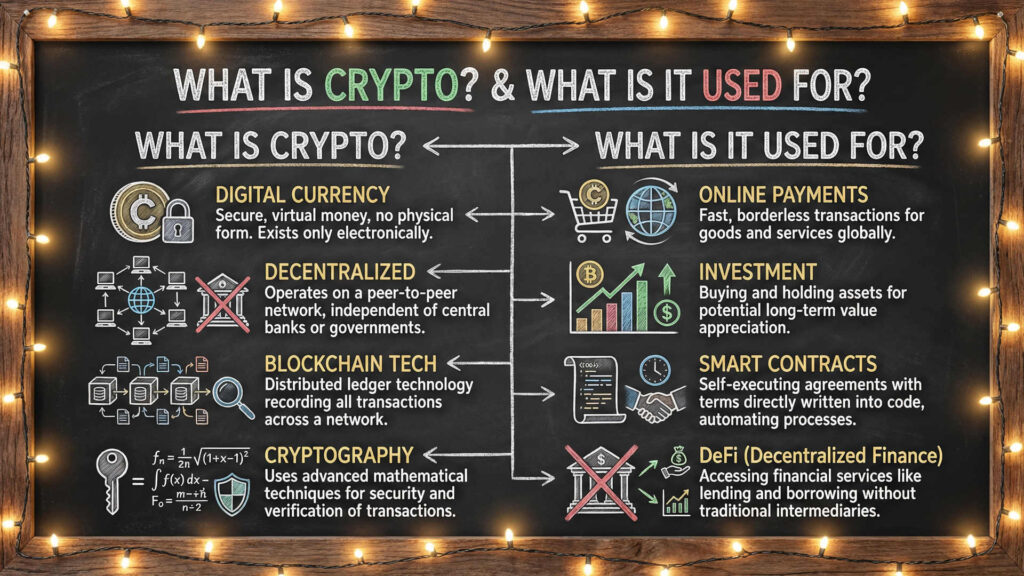
If crypto feels confusing, technical, or intimidating, this explanation is for you. No jargon. No hype. Just the basics. Cryptocurrency is digital money that exists on the internet. It isn’t printed like cash and it isn’t stored at a bank. Instead, it lives on something called a blockchain. Think of a blockchain like a public spreadsheet that anyone can see, but no one can secretly change.
Traditional money is controlled by governments and banks. They decide how much exists and when it can be moved. Cryptocurrency is different. It runs on computer networks instead of banks. You can send it directly to another person, anywhere in the world, without asking permission.
The blockchain keeps track of every transaction. Transactions are grouped into blocks. Those blocks are linked together in order, forming a chain. Once a transaction is added, it cannot be changed or erased. This is why crypto is considered transparent and secure.
Bitcoin And First Usage Of Cryptocurrency
Bitcoin was the first cryptocurrency, created in 2009. It was designed as an alternative to traditional money. Only 21 million Bitcoin will ever exist. Because of this limited supply, many people compare Bitcoin to digital gold.
Bitcoin is not the only cryptocurrency. Ethereum allows smart contracts, which are programs that run automatically. Other cryptocurrencies focus on fast payments, privacy, or powering apps and games.
People use cryptocurrency in several ways.
- To invest or trade.
- To pay for goods and services.
- To use decentralized apps.
- To send money internationally.
- And to protect value from inflation.
The technology behind crypto is very secure, but mistakes can happen. If you lose your password, no bank can recover it. Scams exist, and prices can move quickly.
That’s why learning before investing is important. Cryptocurrency isn’t just about making money. It’s about control, transparency, and financial freedom. It allows people to use money systems without needing a bank. This was a simple explanation of what cryptocurrency is.
What Gives Cryptocurrency Value?
This is one of the most common questions people ask about crypto, and it’s also one of the most misunderstood. People often say things like, “Crypto isn’t backed by anything,” or “It’s just numbers on a screen,” or “How can something digital be worth real money?”
To understand what gives crypto value, we first need to understand what gives anything value in the first place. Money, gold, stocks, and even collectibles all have value for different reasons. Crypto is no different. Value comes from trust, usefulness, scarcity, and belief.
Let’s break this down simply.
10 Great Reasons Value Is Found Within Crypto
First, value comes from agreement.
Money only works because people agree it has value. A dollar bill is just paper. It has no practical use by itself. You can’t eat it, build with it, or power anything with it. What makes it valuable is the shared belief that other people will accept it in exchange for goods and services.

The same principle applies to cryptocurrency. Crypto has value because millions of people agree it does. That agreement didn’t appear overnight. It developed over time as people started using crypto, trading it, and building systems around it.
Second, value comes from scarcity.
Scarcity is one of the strongest drivers of value. Gold is valuable because it’s rare and difficult to mine. Real estate is valuable because land is limited. Art is valuable because it’s unique.
Many cryptocurrencies are valuable because their supply is limited.
Bitcoin is the best example. Only 21 million Bitcoin will ever exist. This limit is built into its code and cannot be changed without the agreement of the entire network. No government or company can print more Bitcoin. This scarcity makes Bitcoin fundamentally different from traditional money, which can be printed in unlimited amounts.
When more dollars are created, each dollar becomes slightly less valuable. This is called inflation. Bitcoin’s fixed supply is one reason people see it as a store of value.
Third, value comes from utility.
Something becomes valuable when it solves a real problem. Cryptocurrency solves several problems at the same time.
- It allows people to send money instantly across borders without banks.
- It allows individuals to store wealth without relying on financial institutions.
- It allows people in countries with unstable currencies to protect their savings.
- It allows transactions to happen 24 hours a day, 7 days a week, without intermediaries.
Some cryptocurrencies go even further. Ethereum allows smart contracts, which are programs that automatically execute when conditions are met. This enables decentralized finance, digital ownership, and applications that don’t rely on a central authority.
When a cryptocurrency has real-world use, demand increases. Demand is a major factor in value.
Fourth, value comes from security.
People value systems they can trust. Cryptocurrencies are secured by cryptography and decentralized networks. Instead of one company or government controlling the system, thousands of computers around the world verify transactions. This makes it extremely difficult to alter records, fake transactions, or shut the system down.
Bitcoin has been running continuously for over a decade without being hacked at the protocol level. That reliability builds trust. And trust builds value.
Fifth, value comes from decentralization.
Traditional financial systems rely on central authorities.

Banks can freeze accounts. Governments can restrict access. Payment processors can block transactions.
Cryptocurrency removes much of this control.
No single entity owns the blockchain. No single person can decide who is allowed to use it.
For many people, especially those who have experienced financial censorship or instability, this freedom is incredibly valuable. The more people who value decentralization, the more value crypto gains.
Sixth, value comes from network effects.
A network becomes more valuable as more people use it.
The internet is valuable because billions of people use it. Social media platforms are valuable because everyone is connected to them. Cryptocurrencies work the same way.
As more people buy, hold, use, and build on a cryptocurrency, it becomes more useful. Businesses begin accepting it. Developers build tools and applications around it. Investors gain confidence. This creates a feedback loop where increased adoption leads to increased value.
Bitcoin and Ethereum benefit heavily from this effect.
Seventh, value comes from transparency.
Most traditional financial systems are opaque. You can’t see how much money is being moved behind the scenes. You can’t verify supply in real time. You have to trust institutions to tell the truth.

Blockchains are transparent by design. Anyone can see transactions. Anyone can verify supply. Anyone can audit the system. This transparency reduces the need for blind trust and increases confidence.
This kind of confidence increases value.
Eighth, value comes from durability.
For something to hold value, it must last. Bitcoin transactions from years ago can still be verified today. The blockchain doesn’t degrade over time. As long as the network exists, the records exist.
This durability is similar to how people trust gold because it doesn’t corrode or disappear. Digital durability is a powerful concept, especially in a world that increasingly lives online.
Ninth, value comes from belief in the future.
A large part of crypto’s value is forward-looking.
People believe cryptocurrency will play a bigger role in the global financial system. They believe it will be used more widely. They believe it will power new applications, services, and economies.
This belief drives investment and development. Just like early investors believed in the internet before it became mainstream, many people believe crypto is still in its early stages.
That belief adds value today.
Tenth, value comes from optionality.
Cryptocurrency gives people options. You can hold it as an investment. You can use it as a tool that can be exchanged for different kinds of money within countries. You can move it across borders. You can store it outside the banking system, which is of course very beneficial. You can participate in decentralized applications.
Having multiple use cases increases value. Assets that can only do one thing are less flexible. Crypto’s versatility makes it more valuable to a wider range of people.
Now, let’s address a common criticism. People often say, “Crypto isn’t backed by anything.” But this raises an important question. What is traditional money backed by?
In the past, currencies were backed by gold. Today, most money is backed by trust in governments and central banks. There is no physical asset backing modern money.
It works because people believe it will continue to work.
Crypto is backed by math, code, networks, and global consensus. It’s backed by users, miners, validators, developers, and infrastructure. It’s backed by utility and demand. Backing doesn’t have to be necessarily physical to be real.
Another criticism is volatility. Crypto prices move a lot. This doesn’t mean crypto has no value. It means the market is still discovering what that value is. New technologies often experience volatility as adoption grows. Over time, as markets mature, volatility tends to decrease. We’ve seen this pattern with many emerging assets.
There is however a great option called overall choice…
People choose crypto.
They choose to hold it.
They choose to build with it.
They choose to accept it.
That choice, repeated millions of times across the world, is what gives cryptocurrency value. Crypto is valuable because people believe in it, use it, protect it, and build around it. It has value to solve problems, offer freedom, and provide many alternatives. It has value because it exists in a world that increasingly needs digital, global, and decentralized systems.
Whether crypto succeeds or fails in the long run is still being written.
But its value today is very real, and it comes from the same place all value comes from.
Human agreement, usefulness, belief and scarcity.
Leave a Reply