Most people think crypto prices move because more people want to buy than sell. That explanation feels intuitive; and it’s also not fully complete.
If that were the full story, price charts would look slow and orderly. They don’t. Instead, crypto prices jump, gap, stall, and reverse. Sometimes this occurs with almost no visible change in interest, usage, or news. Here’s the uncomfortable truth. Crypto prices don’t move because of overall demand. They move because of where demand shows up, how much liquidity exists, and what supply is actually available at that moment.
Two markets can have the same number of buyers and sellers and behave completely differently.
In one, price barely moves. In the other, price explodes or collapses, on relatively small trades. That’s not emotion. That’s structure. Most explanations stop at surface-level slogans:
- Scarcity drives true value.
- More adoption equals higher prices.
- Fixed supply guarantees upside.
Those ideas sound logical, but they quietly ignore how crypto markets actually function minute by minute. They assume supply is static, demand is uniform, and price responds smoothly. None of those assumptions hold in practice.
Crypto markets are thin, fragmented, and reflexive. Supply is technically fixed in some cases but economically available supply is constantly changing. Demand doesn’t arrive evenly. It clusters, disappears, and reappears under stress.
The result is a system where prices can move violently without new money, stall during periods of excitement, or fall despite long-term conviction. This is not about predicting where prices go next. It’s about understanding why they move the way they do, so past market behavior finally makes sense.
If you’ve ever looked at a chart and thought, “Why did that move so fast?” or “Why didn’t price react at all?”, you’re about to get clarity on these issues; not hype or promises, but just the mechanics.
The Big Picture With Macro Context
To understand why crypto supply and demand behave the way they do, we need to step back and look at how supply and demand usually function in more traditional markets.
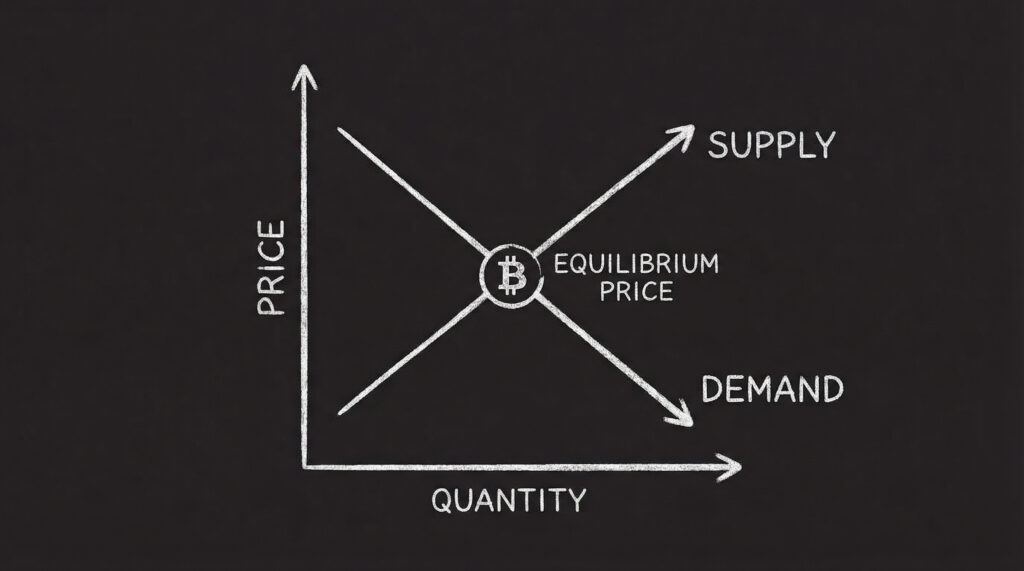
In classical economics, supply and demand are often taught as smooth curves. Supply rises as prices rise. Demand falls as prices rise. Where the two intersect, you get an equilibrium price. While this is a simplification, it works reasonably well for many real-world markets, especially those with deep liquidity, clear regulation, and relatively stable participants.
Take large-cap stocks or major commodities. Shares of a public company don’t suddenly disappear overnight. Oil doesn’t double in price because a few traders changed their minds. These markets are supported by market makers, institutional liquidity, disclosure rules, and a broad base of participants with different time horizons. That depth dampens volatility.
Crypto markets start from a very different baseline.
Liquidity is thinner. Participants are more concentrated. Trading venues are fragmented across dozens of exchanges. Leverage plays a much larger role. As a result, small imbalances can have outsized effects.
In traditional markets, demand tends to accumulate gradually. Pension funds rebalance. Institutions build positions over weeks or months. Supply responds slowly through issuance, production, or corporate actions.
In crypto, demand often arrives in bursts. Narratives spread quickly. Capital rotates fast. Leverage amplifies moves. At the same time, supply may look fixed on paper but behave dynamically in practice due to staking, lockups, vesting schedules, and exchange liquidity.
Another key difference is who sets the price. In traditional markets, price discovery is heavily influenced by institutions operating with size and patience. In crypto, price is often set by whoever is willing to trade right now, even if that group represents a small fraction of long-term holders.
This macro context matters because it explains why crypto prices feel unstable compared to fundamentals. It’s not that supply and demand don’t apply. It’s that they operate in an environment with far fewer shock absorbers. Once you understand that structural difference, the rest of crypto’s behavior starts to make a lot more sense.
What Supply Really Means in Crypto
When people talk about crypto supply, they usually mean one number of total supply. And that’s where the misunderstanding begins. In crypto, supply is not a single concept. It’s a stack of layers, and each layer behaves differently in the market.
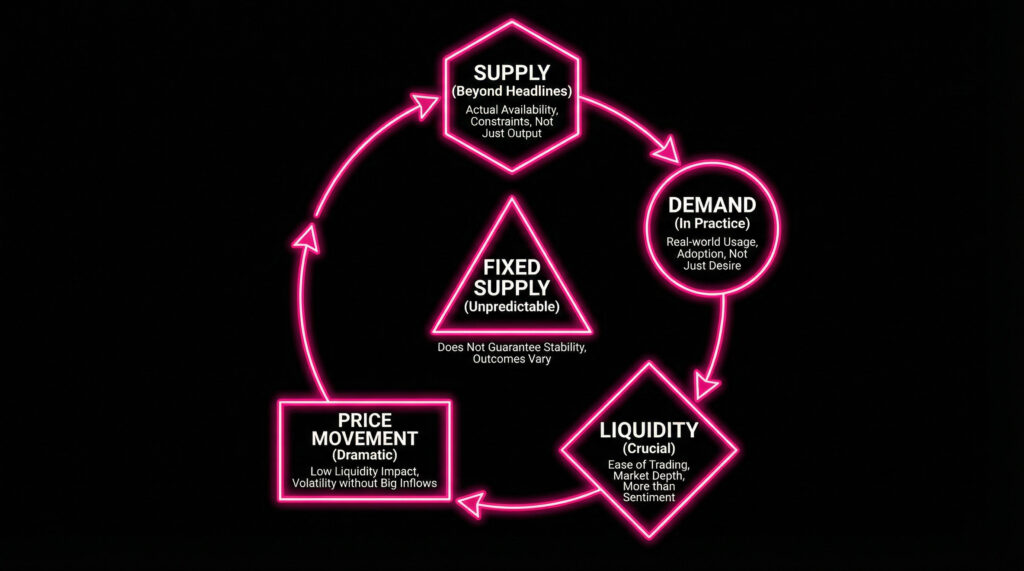
The first layer is total supply. This is the maximum number of tokens that will ever exist, or the number currently defined by the protocol. It’s the number most often quoted in headlines because it sounds authoritative. But total supply tells you almost nothing about near-term price behavior.
The second layer is circulating supply. This is the portion of total supply that has been issued and is theoretically available to the market. This number is more useful—but still incomplete. Circulating supply includes coins that haven’t moved in years, coins held by long-term holders, and coins that are technically transferable but economically inactive.
That leads to the most important layer of the liquid supply.
Liquid supply refers to the coins that are actually available to be sold at current prices. This includes tokens sitting on exchanges, tokens held by short-term traders, and tokens owned by participants willing to transact. This pool is often much smaller than people realize and it can change rapidly.
Finally, there is the effective supply. This is the supply that responds to price changes right now. Effective supply shrinks when holders refuse to sell and expands when fear, leverage, or unlock events push more coins into the market.
Here’s the key insight. Price does not respond to total supply. It responds to effective supply at the margin. A crypto asset can have millions of tokens outstanding and still experience sharp price moves if only a small fraction is actively offered for sale. Conversely, a scarce asset can struggle to move if a steady stream of supply meets every increase in demand.
This is why claims like “low supply guarantees upside” consistently fail. Scarcity on paper does not equal scarcity in the order book.
Once you separate these layers of total, circulating, liquid, and effective supply, then you start to see why crypto prices behave the way they do. And more importantly, why surface-level supply metrics often mislead people who rely on them too heavily.
What Demand Really Means in Crypto
Just like supply, demand in crypto is often described in a way that sounds right but misses the mechanics. People usually think of demand as interest. More users. More hype. More attention. But markets don’t respond to interest. They respond to orders placed at specific prices.
In practical terms, demand is not a feeling or a narrative. Demand is a set of buy orders where some are visible and some are hidden while being distributed across a range of prices. Every buyer has a limit, or a price they’re willing to pay, and a size they’re willing to buy.
This matters because demand is price-sensitive, not absolute.
There can be the following present…
- Strong interest in an asset
- Positive sentiment across social media
- Growing overall usage or attention
And still also the price stalls or falls since buyers are not willing to transact at higher prices.
In crypto, much of demand is also conditional. Traders wait for pullbacks. Algorithms buy only if momentum confirms. Institutions scale in slowly. Retail chases breakouts but disappears during consolidation. None of this shows up as demand until orders actually hit the book.
Another critical distinction is spot demand vs leveraged demand.
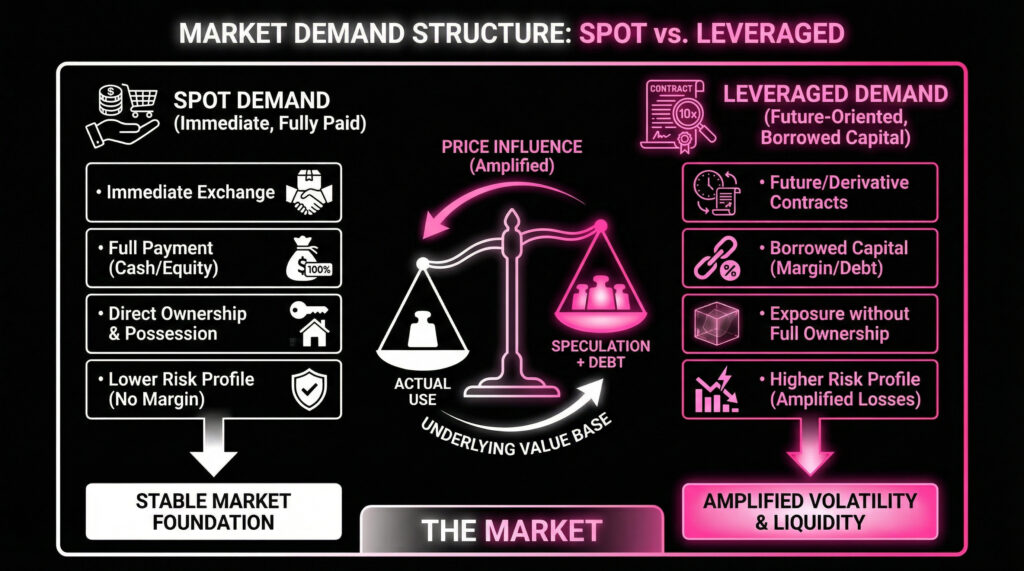
Spot demand represents real capital committing to ownership. Leveraged demand represents temporary exposure that can vanish instantly if price moves the wrong way.
Both can push price up though only spot is very stable.
This is why demand often looks powerful on the way up and fragile on the way down. When price rises, new buyers appear. When price stalls, demand can evaporate without warning and not because belief changed, but because price exceeded what buyers were willing to pay.
Demand is not how many people want an asset. It’s how aggressively they’re willing to buy it right now and at current prices.
Once you understand demand this way, price behavior starts to look less emotional and more mechanical. That can be key to staying calm within these moments found in the crypto world.
How Supply Enters The Market (Minting, Unlocks, Emissions)
Even when a crypto asset has a clearly defined maximum supply, new supply can still enter the market continuously. This is one of the most misunderstood dynamics in crypto and one of the most important for understanding price behavior.
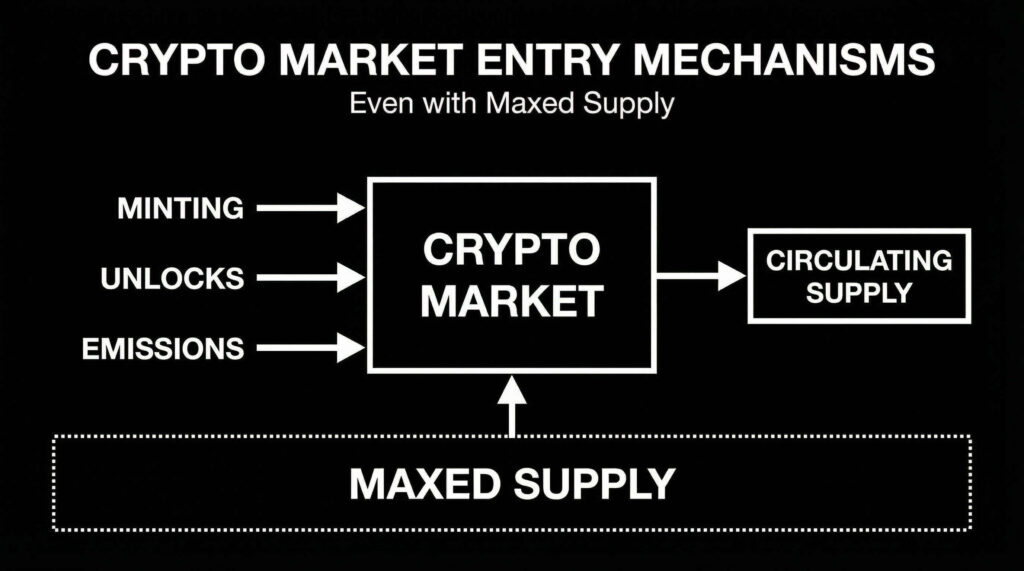
The first pathway is issuance through mining or validation rewards. In proof-of-work systems, new coins are minted as block rewards. In proof-of-stake systems, new tokens are often issued as staking rewards. In both cases, these tokens are not theoretical, they are paid to participants who must decide whether to hold or sell. If those participants regularly sell to cover costs or lock in returns, new supply steadily meets demand over time here.
The second pathway is token emissions tied to incentives. Many networks issue tokens to bootstrap activity: liquidity incentives, developer grants, ecosystem rewards. These emissions are often framed as growth investments, but from a market perspective, they are supply injections that need buyers to absorb them over time.
Then also thirdly, there are vesting schedules and unlocks.
Early contributors, investors, and foundations frequently receive tokens that unlock over time. On paper, these tokens already exist. In reality, they are invisible to the market until they unlock. When they do, effective supply can expand sharply, especially if holders choose to sell into liquid markets.
This is why markets often react before unlock events. Price doesn’t wait for supply to hit exchanges—it adjusts when participants anticipate that supply will become sellable.
Another subtle factor is distribution concentration. If new supply flows primarily to participants with low holding conviction such as miners, liquidity providers, or short-term funds then it is more likely to become active selling pressure. If it flows to long-term holders, the impact can be muted.
The key takeaway is simple but critical here. Fixed supply does not mean fixed selling pressure.
Supply enters the market not all at once, but through predictable – and sometimes underestimated channels. Understanding those channels helps explain why price can struggle even during periods of apparent growth, and why timing matters as much as totals.
How Supply Leaves The Market (Burns, Lockups, Inactivity)
Supply doesn’t just enter crypto markets. It can also greatly leave them, at least economically. This side of the equation is discussed far less often, yet it plays a major role in shaping effective supply and price behavior itself.
One mechanism is token burning. Some protocols permanently destroy a portion of tokens through fees, penalties, or scheduled burns. When done consistently and transparently, burns reduce total supply over time. However, their real impact depends on scale. A burn that looks impressive in percentage terms may still be insignificant relative to daily trading volume.
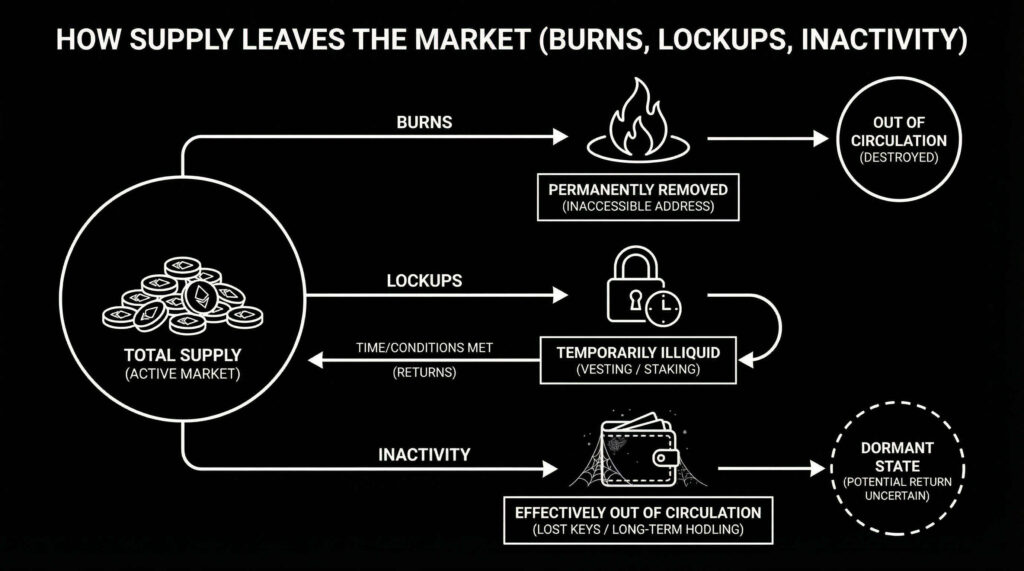
Another and second major factor is staking and lockups.
When tokens are staked or locked in smart contracts, they become temporarily unavailable for sale. This reduces liquid supply, sometimes dramatically. During periods of strong conviction, large portions of supply can be locked away, tightening the market and increasing sensitivity to demand shifts.
But lockups are not permanent. They represent delayed supply, not destroyed supply. When lock periods end or when yields fall, those tokens can quickly re-enter the market, expanding effective supply again.
Then there is inactivity. A substantial portion of crypto supply hasn’t moved in years. Coins may be lost, forgotten, or held by long-term participants with no intention to sell. From a market perspective, these coins are functionally removed from circulation, even though they still count toward total and circulating supply metrics.
This is why two assets with the same circulating supply can behave very differently. If one has a large base of inactive or committed holders, its effective supply is smaller and less reactive to price changes.
The critical insight is the following. Supply leaving the market doesn’t have to be destroyed to matter. It just has to become unavailable.
Burns, lockups, and inactivity all shrink the pool of tokens that can respond to price movements. That can amplify demand when it appears but it can also reverse quickly when conditions change. Understanding this dynamic helps explain both sudden rallies and equally sudden reversals.
How Demand Forms in Practice (Not Theory Alone)
Now that we’ve separated what supply is from what supply does, it’s time to look at demand the same way, through the lens involving behaviors, not assumptions.
In practice, crypto demand does not come from a single group with a single motivation. It comes from different participants acting for different reasons, on different timelines. That diversity is exactly why demand can appear strong one moment and vanish the next.

Start with retail participants. Retail demand is usually reactive. It tends to show up after price moves, headlines spread, or narratives gain traction. This demand is often aggressive but short-lived. It can push price quickly, especially in thin markets. It is also the first to disappear when momentum slows or volatility increases.
Then there are traders and speculators. Their demand is conditional by design. They buy breakouts, pullbacks, or specific technical setups. If those conditions fail, demand turns into supply almost instantly. This creates sharp transitions where buying pressure flips into selling pressure without any change in fundamentals.
Next is institutional and professional demand. This demand is slower, more price-sensitive, and often less visible. Institutions rarely chase price. They scale into positions, use derivatives to manage exposure, and may pause entirely if liquidity is insufficient. When institutional demand is present, it stabilizes markets, but it rarely announces itself.
There is also protocol-driven demand. Some demand comes from the need to use a token: paying fees, posting collateral, participating in governance, or accessing services. This type of demand is often overstated. Utility demand matters but it usually operates in the background and grows gradually rather than driving sudden price moves.
Remember that demand is fragmented, conditional, and time-bound.
Price moves not when “everyone believes”, but when enough participants decide to act at the same time and when supply is thin enough to let those actions matter.
Understanding who is buying, why they’re buying, and how long that demand is likely to persist is far more important than measuring attention or sentiment alone.
Liquidity: The Missing Piece Most People Ignore
Liquidity is the quiet force behind most crypto price movements, and it’s the variable almost everyone overlooks.
Liquidity is not volume. It’s not market cap. It’s not how popular an asset is. Liquidity is the market’s ability to absorb trades without significantly moving price.
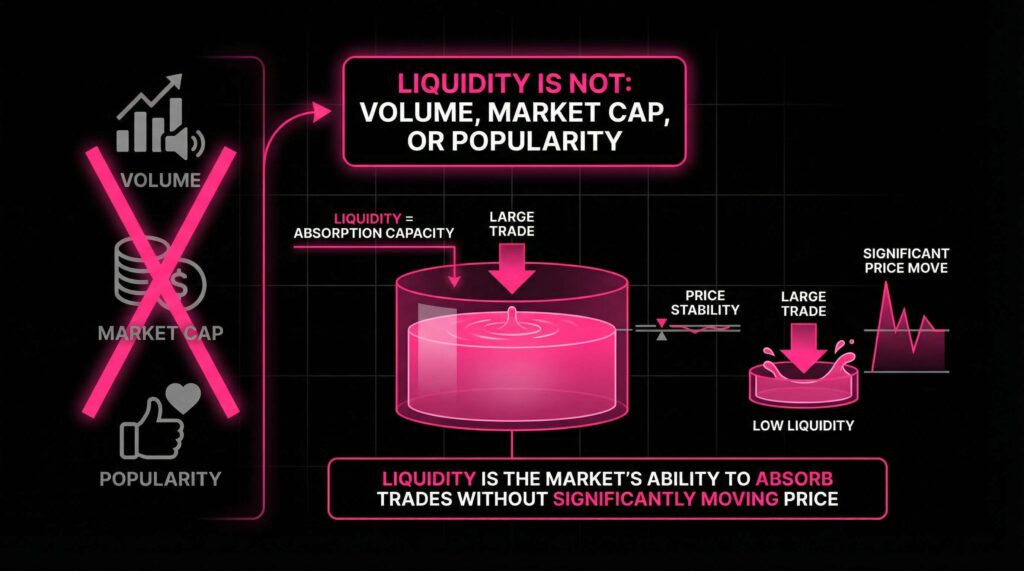
In highly liquid markets, large buy or sell orders can be executed with minimal price impact. In low-liquidity markets, even modest trades can push price sharply higher or lower. Crypto, as a whole, operates much closer to the second scenario than most people realize.
This is why crypto prices can move dramatically without new money entering the ecosystem. If liquidity is thin, price doesn’t need a wave of buyers, it just needs the absence of sellers. A few aggressive market orders can chew through the available sell orders, forcing price upward until new supply appears.
The same dynamic works in reverse. When liquidity dries up on the bid side, price can fall quickly even if long-term holders haven’t changed their views. It’s not panic. It’s empty space in the order book.
Liquidity also changes over time.
During periods of optimism, more participants place limit orders, spreads tighten, and markets feel stable. During uncertainty or stress, liquidity providers pull back. Order books thin out. Spreads widen. The market becomes fragile and more sensitive to every trade.
This is why volatility often clusters. It’s not just emotion. It’s a structural withdrawal of liquidity.
Another subtle point is where liquidity exists. Liquidity concentrated near the current price stabilizes markets. Liquidity far away does very little. If there’s no depth close to price, even small demand imbalances can cause large moves before the market finds resistance.
Liquidity determines how much demand or supply is required to move price… not conviction, not narratives, and not market cap.
Once you start looking at crypto through the lens of liquidity, many mysterious price moves stop being mysterious at all.
Price Is Set at The Margin (Why Small Trades Matter)
One of the most counterintuitive ideas in crypto markets is this: Price is not set by the average participant. Price happens to be set at the margin.
That means the market price reflects the last trade that cleared, not the collective conviction of all holders, users, or believers. Millions of people can agree an asset is valuable and price can still fall if the marginal buyer steps away.
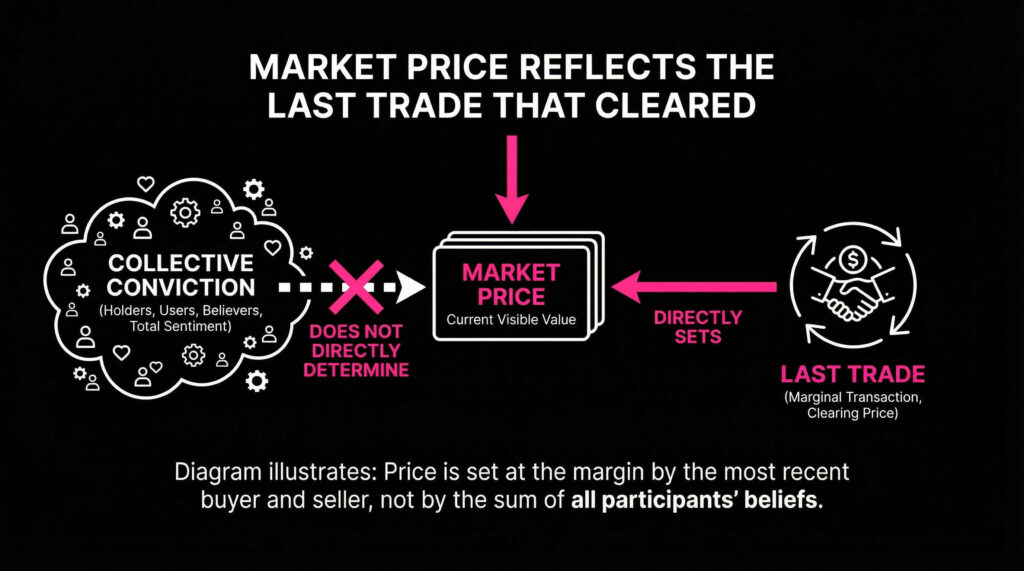
In an order book–based market, price moves when an incoming order consumes the nearest available liquidity. If there are very few sell orders close to the current price, even a relatively small buy can push price up several levels. Nothing fundamental changed. No mass adoption occurred. The market simply ran out of sellers at nearby prices.
The same logic applies on the way down.
If buy orders are thin or pulled entirely, a modest sell order can cascade through the book, pushing price lower until it finds demand willing to step in. That’s why price drops often feel faster and more violent than rallies, not because fear is stronger than optimism, but because liquidity disappears asymmetrically.
Headlines like “Billions wiped off market cap” are misleading. Market cap is a calculation based on the marginal price multiplied by total supply. It does not mean billions of dollars actually traded hands. In reality, price may have moved on a fraction of that amount.
Understanding marginal pricing also explains why:
- Sideways markets can persist despite strong conviction
- Breakouts can happen suddenly after long periods of quiet
- Reversals can occur without warning or news
Price moves when the balance of immediate willingness to transact changes and not when long-term beliefs shift. This is a critical mental reset. Crypto markets are not voting machines where every opinion is counted. They are clearing mechanisms where the most urgent buyers and sellers at the edge of liquidity determine the outcome.
Once you internalize that price is set at the margin, volatility stops looking irrational. It begins looking inevitable in a market built on thin, dynamic liquidity.
Common Myths About Crypto Supply and Demand
By this point, the mechanics of supply and demand in crypto should already feel more complex than the slogans that usually circulate online. This section exists to directly dismantle a few of the most persistent myths – because these misunderstandings are where many people get misled.
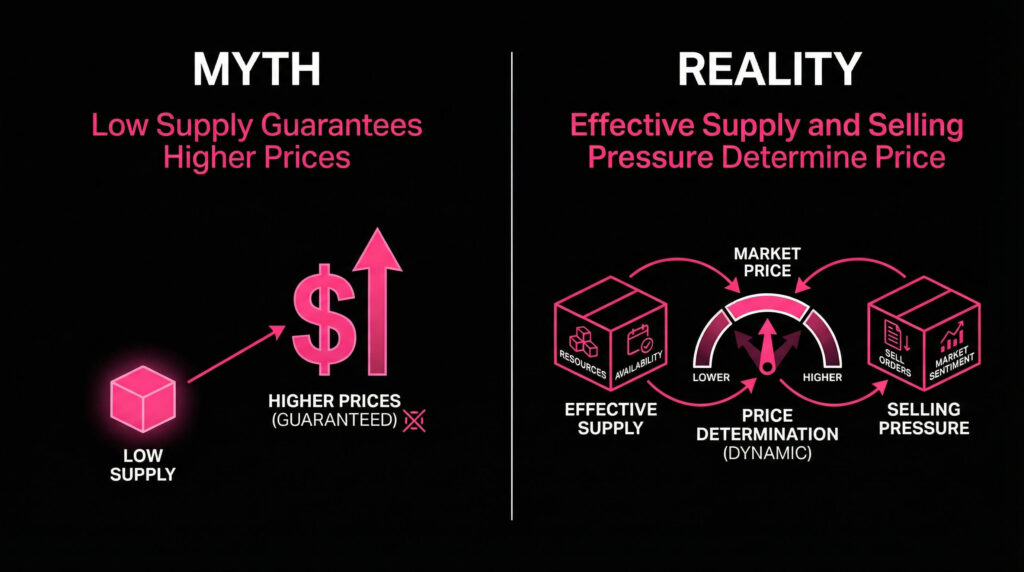
Myth 1: Low supply automatically means higher price.
Scarcity alone does nothing. What matters is how much of that supply is actually available to sell. A token with a low total supply but a steady stream of sellers can underperform an asset with a larger supply but tighter effective circulation. Price responds to selling pressure, not headline numbers.
Myth 2: High demand guarantees price increases.
Demand that isn’t willing to pay higher prices doesn’t move markets. Interest, attention, and even adoption can rise while price stagnates if buyers are price-sensitive or if new supply meets them at every level. Demand must be aggressive and immediate to matter.
Myth 3: Market cap shows how much money is invested.
Market cap is a mathematical snapshot, not a cash ledger. It reflects the marginal price multiplied by total supply, not the amount of capital committed. Large changes in market cap can occur with relatively small trading volumes when liquidity is thin.
Myth 4: If fundamentals are strong, price will follow.
Fundamentals matter over long time horizons, but price is set in the short term by liquidity, leverage, and positioning. Strong fundamentals do not prevent drawdowns, nor do weak fundamentals prevent temporary rallies.
Myth 5: Whales control everything.
Large holders influence markets, but they still operate within liquidity constraints. Many sharp moves occur not because someone acted, but because others didn’t. Liquidity was absent when it was needed.
The unifying lesson across these myths is simple. Crypto prices are shaped more by structure than by stories. Once these myths are stripped away, supply and demand stop feeling out there and instead appear like a system governed by incentives, availability, and urgency rather than slogans or guarantees.
Risk Analysis: Where Supply & Demand Break Down
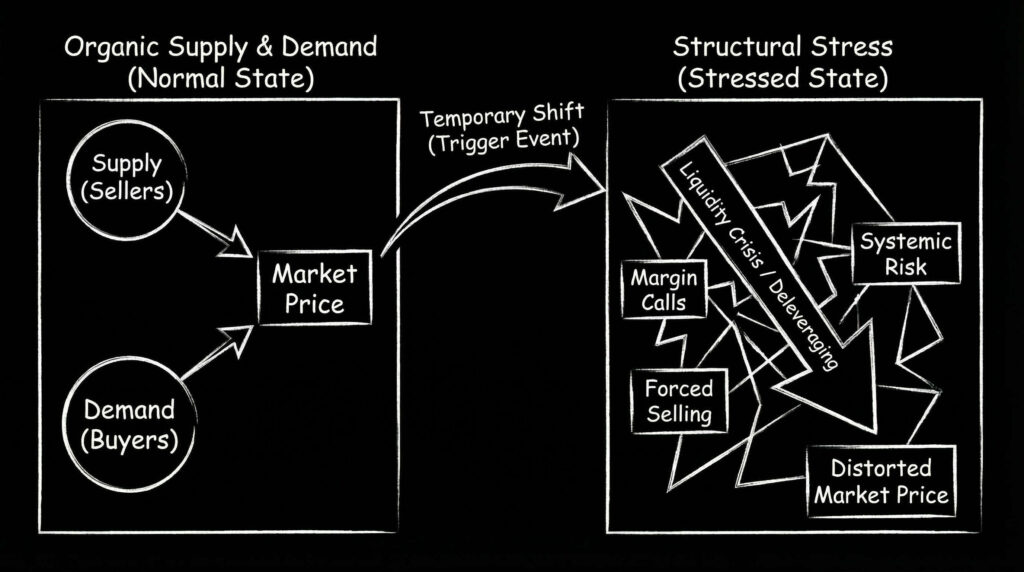
Up to this point, we’ve treated supply and demand as if they operate cleanly. In reality, there are moments when normal supply-and-demand logic is overwhelmed by structural risks unique to crypto markets. This section exists to make those failure points explicit.
The first breakdown comes from leverage.
A large portion of crypto demand is not spot buying, it’s borrowed exposure. When leverage is high, demand becomes fragile. Prices can rise quickly as leveraged positions stack on top of one another, but the same structure creates forced selling when price moves even slightly against those positions. Liquidations introduce non-optional supply into the market. These sellers are not responding to valuation or conviction – they are responding to margin rules.
This is how liquidation cascades form. Supply suddenly floods the market not because holders changed their minds, but because the system forced them out.
The second breakdown comes from unlock and emission shocks.
Vesting schedules, reward distributions, or protocol changes can cause effective supply to expand rapidly. Even if participants believe in the long-term value of the asset, the short-term increase in sellable tokens can overwhelm demand, and especially if liquidity is thin. Markets often price this in early, leading to weakness before the supply officially becomes tradable.
The third risk is sentiment-driven reflexivity.
In crypto, price itself influences behavior. Rising prices attract demand. Falling prices suppress it. This feedback loop can push markets far away from equilibrium in both directions. When sentiment flips, demand doesn’t gradually decline, it can disappear almost instantly, leaving price unsupported.
Finally, there is liquidity withdrawal risk.
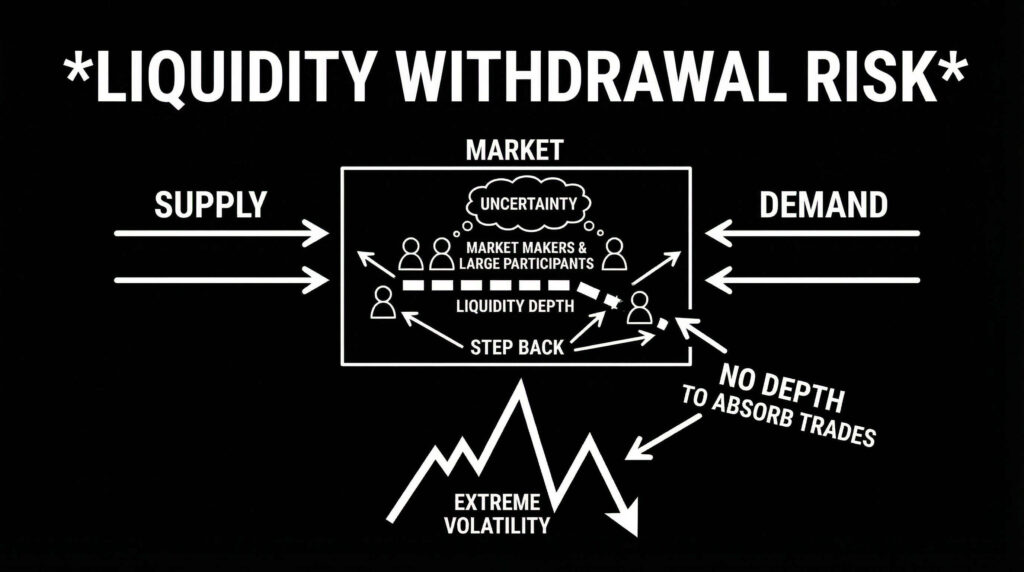
Market makers and large participants do not provide liquidity unconditionally. During uncertainty, they step back. When that happens, even balanced supply and demand can produce extreme volatility simply because there’s no depth to absorb trades.
Try to understand… crypto markets can temporarily stop reflecting organic supply and demand and start reflecting structural stress instead.
Understanding where and why this happens doesn’t eliminate risk. It does explain why price sometimes behaves in ways that feel disconnected from logic, fundamentals, or fairness.
Opportunity Analysis: When Supply & Demand Matter
After walking through where supply and demand break down, it’s important to be precise about when they do provide useful signal. This section is not about optimism or timing markets. It’s about identifying conditions where supply and demand dynamics become more informative and less distorted by leverage, panic, or structural stress.
Supply and demand matter most when effective supply is constrained and demand arrives without excessive leverage.
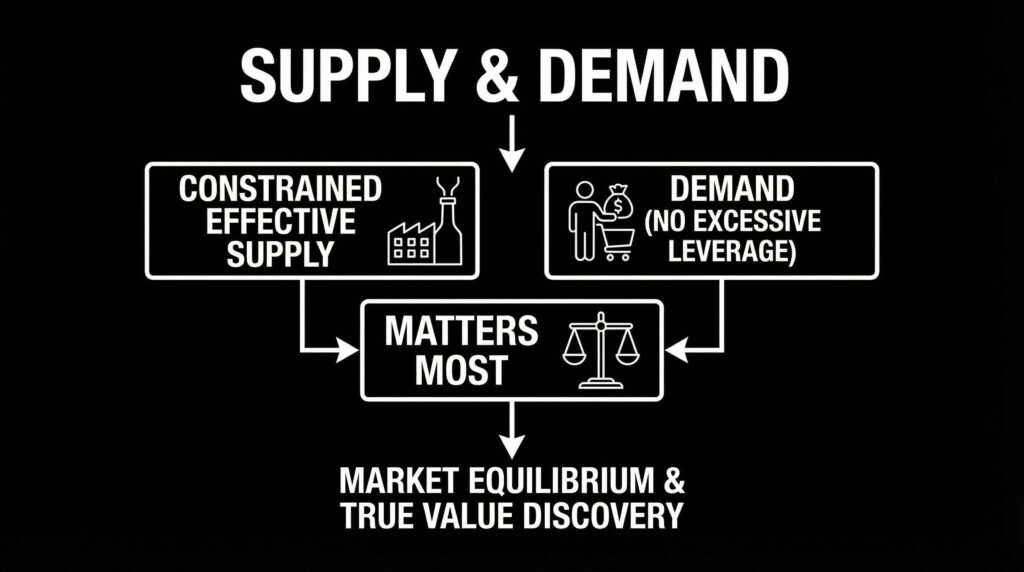
Constrained effective supply doesn’t mean low total supply. It means a meaningful portion of tokens are unavailable to sell because they’re locked, staked, inactive, or held by participants with low urgency. In these environments, new demand doesn’t need to be explosive to matter. It just needs to be persistent enough to absorb what little supply is offered near the current price.
Equally important is the quality of demand. Demand driven primarily by spot buying or capital that is not immediately forced out by small price moves, tends to interact more cleanly with supply. When buyers are not over-leveraged, price discovery slows down, volatility compresses, and moves become more incremental rather than chaotic.
Liquidity also plays a central role here. When order books are reasonably deep near price, markets can process demand without extreme slippage. This creates a feedback loop where participants are more willing to place limit orders, further stabilizing price behavior. In these conditions, price becomes more responsive to gradual changes in participation rather than sudden gaps.
Another situation where supply and demand matter more is during structural transitions. Examples include declining emissions, reduced unlock schedules, or sustained shifts in holding behavior. These changes don’t guarantee outcomes, but they do alter the balance of what the market must absorb over time.
Supply and demand are most informative when markets are calm enough to let them operate.
They don’t eliminate risk, and they don’t make price predictable. But in the absence of extreme leverage, forced selling, or liquidity withdrawal, they become a useful lens. This is not a lens for forecasting, although it’s one for understanding why markets behave the way they do in certain phases.
Comparison: Crypto vs Stocks vs Commodities
To really understand crypto supply and demand, it helps to see it side by side with other markets people intuitively understand – stocks and commodities. Many misunderstandings come from applying the wrong mental model to crypto alone.
Let’s begin with stocks. In equity markets, supply is relatively stable in the short term. Shares don’t appear or disappear daily. Issuance events like secondary offerings are regulated, scheduled, and widely disclosed. Demand is dominated by institutions with long time horizons, and liquidity is deep. Market makers and regulations smooth out price discovery. As a result, supply and demand interact gradually, and large price moves usually require large changes in information or expectations.
Commodities operate differently, but they also have stabilizers. Supply responds to production capacity, extraction costs, and physical constraints. Demand comes from real-world usage involving energy, manufacturing, consumption. These markets move with cycles, but they are anchored by physical realities. You can’t instantly double oil supply, and you can’t delete it with a software update.
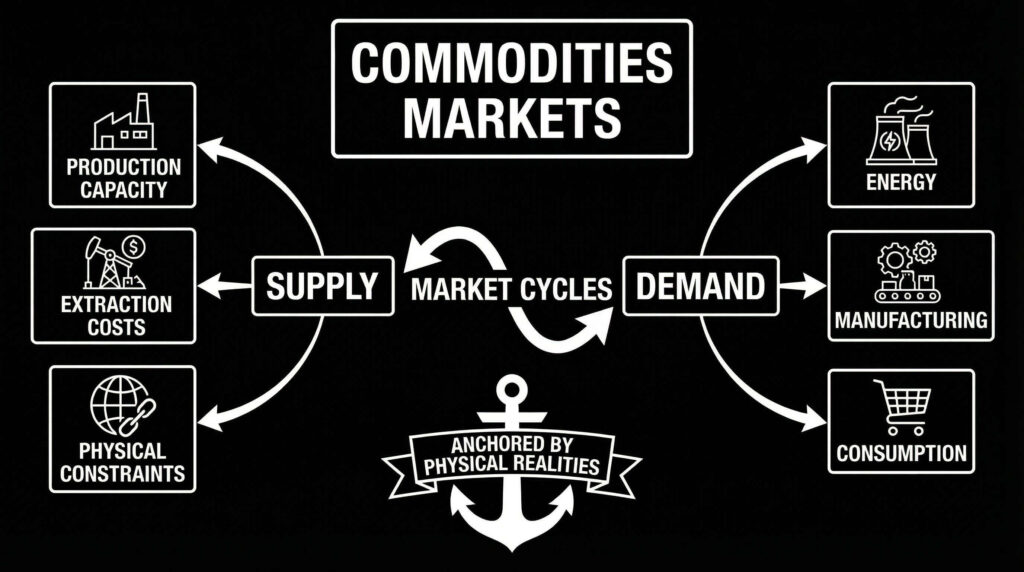
Crypto sits in between but with fewer guardrails.
Crypto supply is algorithmic and transparent, but not static in practice. Emissions, unlocks, burns, and incentives constantly reshape effective supply. Demand is not tied to consumption in the same way commodities are, nor is it anchored by regulated capital flows like equities.
Liquidity is the biggest divergence. Crypto liquidity is fragmented across exchanges, often thin near price, and highly sensitive to sentiment and leverage. This makes price far more responsive to marginal changes in supply or demand than in traditional markets.
Another difference is participant composition. Crypto markets are still heavily influenced by retail traders and short-term speculators, while stocks and commodities are dominated by institutions, hedgers, and long-term capital. That difference alone explains much of crypto’s volatility.
The takeaway is not that crypto is worse or better. It’s that crypto is structurally different. Applying stock or commodity assumptions to crypto supply and demand leads to false expectations. Once those differences are understood, crypto price behavior stops feeling irrational and starts looking like a market behaving exactly as its structure would suggest.
Long-Term Implications (No Price Predictions)
When people talk about the long term in crypto, it’s often framed as a price outcome. This section is intentionally different. The long-term implications worth paying attention to are structural, not numerical.
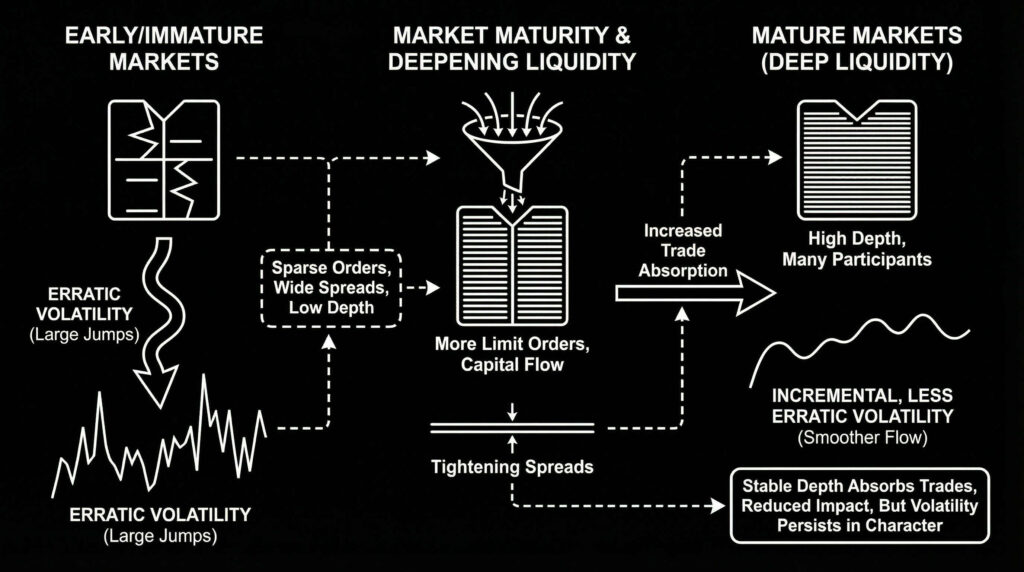
Over time, crypto markets tend to evolve along a few consistent dimensions: liquidity, participant mix, and supply behavior. This is true as it’s gotten more known over time.
As markets mature, liquidity generally deepens. More participants place limit orders. More capital is willing to transact near the current price. Spreads tighten. This doesn’t remove volatility, but it changes its character. Price movements become less erratic and more incremental because the market can absorb trades without immediately running out of depth.
Supply dynamics also tend to evolve. Early-stage networks often rely heavily on emissions and incentives to bootstrap activity. As networks mature, those emissions frequently decline, vesting schedules complete, and the pace at which new supply enters the market slows. None of this guarantees favorable outcomes, but it does change what the market must continuously absorb.
Another long-term shift is holder behavior. Over extended periods, supply often migrates from short-term participants to longer-term holders. This doesn’t eliminate selling pressure but it redistributes it. Effective supply becomes less reactive to short-term price fluctuations, which can reduce reflexive swings driven purely by sentiment.
Importantly, these changes are gradual and uneven. Crypto markets do not move cleanly from immature to mature. They cycle between phases. Liquidity can improve for years and then retreat during stress. Supply can tighten and then loosen again as incentives change.
Understand that long-term outcomes in crypto are shaped by how market structure evolves, not by any single narrative or metric.
Understanding supply and demand as dynamic systems rather than static facts helps frame crypto as an evolving market. One where behavior, incentives, and structure matter more over time than short-term excitement or fear.
How To Ultimately Think About Supply & Demand
This section is not about what to buy, when to buy, or how to time markets. It’s about building a clear mental framework so supply and demand stop feeling abstract, and begin becoming something you can reason about calmly.
The first question to ask is always: What supply is actually available right now?
Ignore total supply at first. Focus instead on effective supply near the current price. Are tokens heavily staked or locked? Are long-term holders inactive? Or is there a steady stream of new tokens entering the market through emissions or unlocks? Price responds to what can be sold, not what exists on paper.
Next, ask: Who is providing demand and under what conditions?
Is demand coming from spot buyers with longer time horizons, or from short-term traders using leverage? Conditional demand behaves very differently from committed demand. If price moves slightly against it, will that demand persist or disappear?
Then question and consider all the liquidity near price.
How deep is the order book where price is trading right now? Are there real bids and offers close by, or large gaps? Thin liquidity means small changes in supply or demand can cause outsized moves. Deep liquidity means the market can absorb activity without dramatic price changes.
Another critical question is: What happens if conditions change suddenly?
If price drops, does supply increase due to liquidations or unlocks? If price rises, does new supply emerge from holders willing to sell into strength? These reactions often matter more than the initial move itself.
Finally, separate structure from narrative. Narratives explain why people care. Structure determines how price moves. When the two align, markets feel orderly. When they don’t, volatility increases.
This framework doesn’t make markets predictable. But it does make them legible, and that’s the difference between reacting emotionally and understanding what you’re actually seeing unfold.
Final Reality Check And Summary
At this point, the goal isn’t to remember every mechanic or diagram. It’s to leave with a clearer mental model of why crypto prices behave the way they do, especially when that behavior feels confusing or disconnected from headlines.
Crypto prices do not move because everyone suddenly agrees on value. They move because supply and demand interact at specific prices, within specific liquidity conditions.
What matters most in the short to medium term is not total supply, long-term belief, or broad interest. What matters most is actually effective supply, immediate demand, and how much liquidity exists at the margin. When those elements are stable, price behavior feels slower and more rational. When they aren’t, even small imbalances can produce large, sudden moves.
This is why crypto often feels chaotic. It’s not because the market is random. It’s because it operates with fewer buffers. Thin liquidity, fragmented venues, leverage, and conditional participation all compress decision-making into short windows of time. Price responds to urgency, not consensus.
It’s also why familiar narratives can fail. Fixed supply doesn’t prevent drawdowns. Growing adoption doesn’t guarantee upward price movement. Strong fundamentals don’t override market structure in the short term. Once understood, many past market moments become easier to interpret, not in hindsight, but in logic. Sudden rallies, sharp drops, long consolidations, and violent reversals all start to follow the same structural patterns.
Crypto markets are not broken. They are behaving exactly as their structure allows.
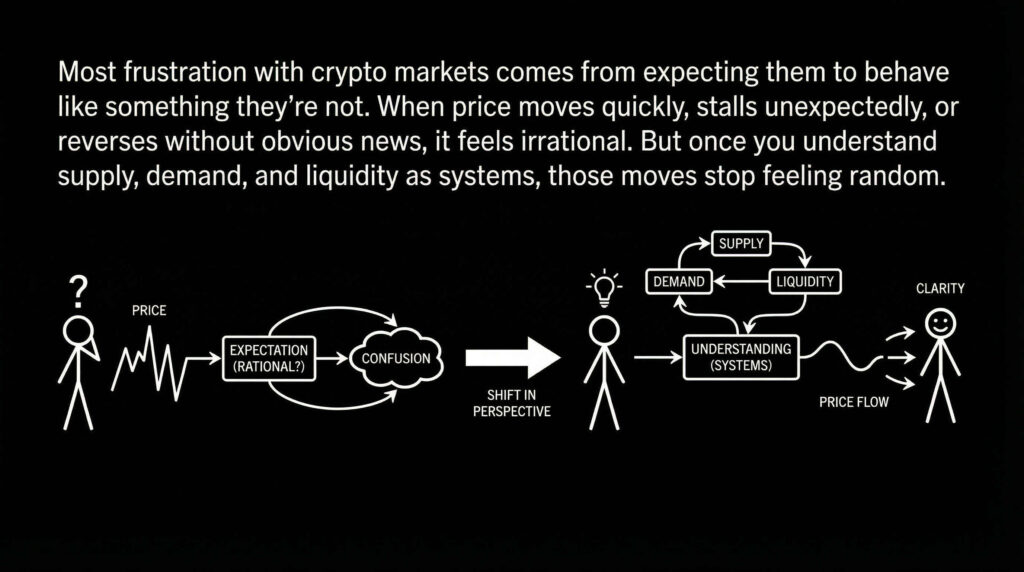
Understanding that doesn’t remove risk. But it replaces confusion with clarity. This replaces emotional reactions with a framework grounded in how price is actually formed.
If there’s one thing to take away from this entire discussion, it’s not a conclusion about where crypto is going; it’s a shift in how to interpret what you’re seeing.
Most frustration with crypto markets comes from expecting them to behave like something they’re not. When price moves quickly, stalls unexpectedly, or reverses without obvious news, it feels irrational. But once you understand supply, demand, and liquidity as systems, those moves stop feeling random.
This video wasn’t meant to simplify crypto into slogans. It was meant to give you a foundation… one you can reuse every time you look at a chart, hear a new narrative, or see a sudden price move that doesn’t seem to make sense.
Future topics like volatility cycles, market phases, risk management, leverage effects, even long-term adoption… only really click once this foundation is in place. Without it, everything else feels like noise. With it, patterns start to repeat in recognizable ways.
You don’t need to predict markets to understand them. And understanding them doesn’t require constant action. The goal rather is that when something moves, you can pause and ask why, using structure instead of emotion as your guide.
If you continue exploring crypto through that lens, each new concept builds on the last, rather than contradicting it. That’s how clarity compounds over time. Thanks for reading and visiting.
Leave a Reply