Most explanations of Bitcoin start in the wrong place. They begin with price charts or slogans like “Bitcoin is really digital gold”. But none of that explains the most important question concerning how a purely digital system keeps track of ownership without a central authority.
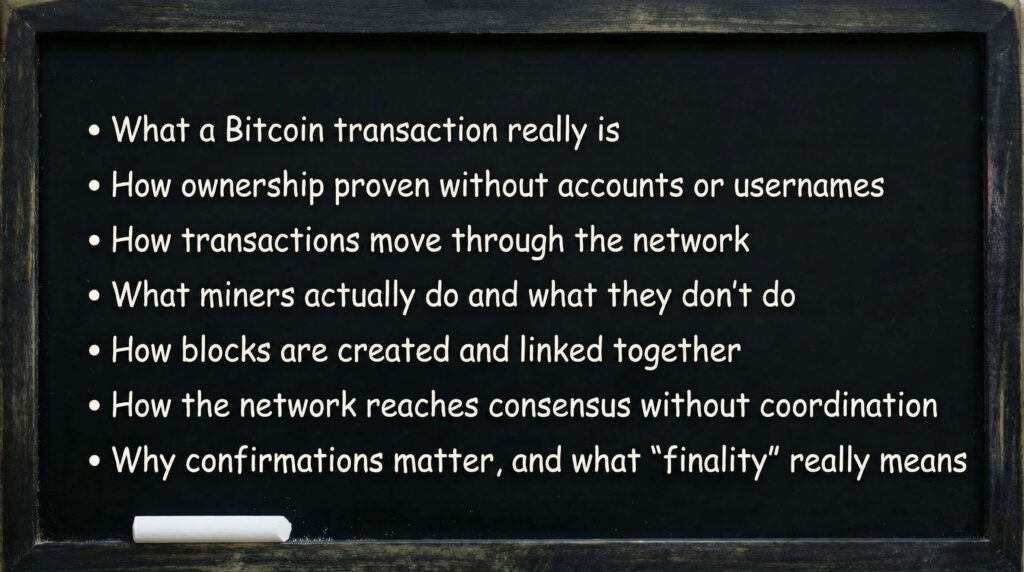
We can now go over several steps in understanding with fullness some bitcoin knowledge.
If you think about all of this carefully, this really shouldn’t work. Digital files are easy to copy. Databases are easy to edit. Online systems usually rely on a company, a server, or a trusted administrator to keep records honest.
Bitcoin has none of those concerns though.
There is no central ledger you can audit. No company approving transactions. No authority deciding which payments are valid.
And yet, people all over the world can send value to each other, settle transactions, and independently agree on who owns what… using nothing more than software, cryptography, and economic incentives.
Bitcoin isn’t impressive because it’s scarce, fast, or valuable. It’s impressive because it solves a coordination problem that normally requires trust. It replaces institutional enforcement with rules that anyone can verify and incentives that make cheating irrational.
If Bitcoin were just digital money, it would be trivial to shut down or manipulate. If it were just a database, it would need an owner. Instead, Bitcoin is a system where thousands of independent computers, most of which don’t trust each other, continuously agree on a single shared history.
They don’t agree by voting or by reputation. They agree by math, verification, and cost.
Let’s get to understanding that system step by step. Not in abstract terms, and not in slogans, but in plain mechanics. Let’s understand what actually happens when a Bitcoin transaction is created, how it’s checked, how it gets recorded, and why that record is so difficult to change afterward.
The Big Picture And Macro Context
To understand why Bitcoin exists at all, you have to start with a problem that sounds simple but isn’t. How do you create digital money without a trusted middleman?
On the internet, copying information is effortless. You can duplicate a file perfectly, instantly, and at almost no cost. That’s a feature for photos and documents, but it’s a fatal flaw for money. If digital value can be copied, then ownership becomes meaningless. This is known as the double-spend problem.
If there’s no central authority keeping a master record, what stops someone from sending the same digital money to two different people? In traditional systems, the answer is straightforward: a bank, payment processor, or platform maintains a centralized ledger. They decide which transaction happened first, update balances, and reject anything invalid.
That model works but it requires trust. You must trust the institution to:
- Keep accurate records
- Enforce rules consistently
- Remain fully solvent
- Resist censorship or pressure
- Stay online and operational
Bitcoin asks a different question: What if you remove the trusted party entirely?
That’s where things get difficult. Without a central referee, you need a way for thousands of independent computers spread across the world to agree on a single transaction history, even if some participants are dishonest or offline.
This is not a Bitcoin-specific problem. It’s a general computer science challenge, meaning a distributed consensus in an adversarial environment. Before Bitcoin, most attempts to solve this required either a small, known group of validators, or some form of identity, permission, or central coordination.
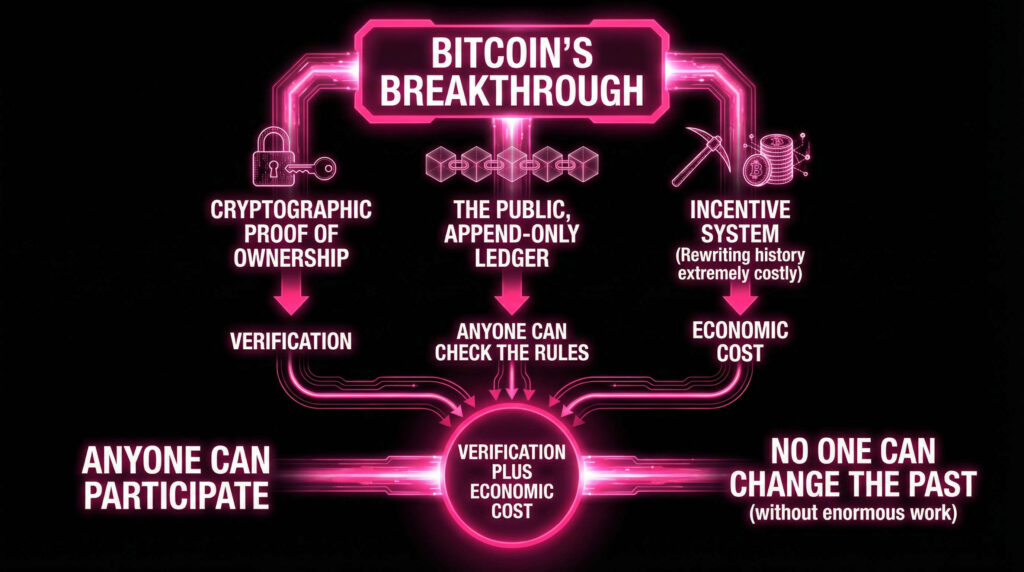
Bitcoin’s breakthrough was combining three ideas:
- Cryptographic proof of ownership
- A public and append-only ledger
- An incentive system that makes rewriting history too costly
Instead of trusting an institution, Bitcoin relies on verification plus economic cost. Anyone can participate. Anyone can check the rules. And no one can change the past without doing an enormous amount of work.
This macro context matters because every design choice you’ll see next including transactions, blocks, mining, confirmations… exists to solve this single problem. This problem is how to keep a shared history honest without trusting anyone in charge.
Before walking through a Bitcoin transaction step by step, we need a small set of building blocks. These are the minimum concepts Bitcoin uses to function. You don’t need to memorize math or code but just understand what each piece does in the system.
Start with private keys and public keys. A private key is a secret number only the owner knows. From it, a public key is mathematically derived. The critical property is that you can prove you control the private key without revealing it. Bitcoin uses this to prove ownership without accounts or identities.
That proof comes from digital signatures. When you spend bitcoin, you don’t move coins; you create a message that says, “I authorize this spend,” and you sign it with your private key. Anyone can verify the signature using the public key, but no one can forge it without the private key. This is how authorization works.
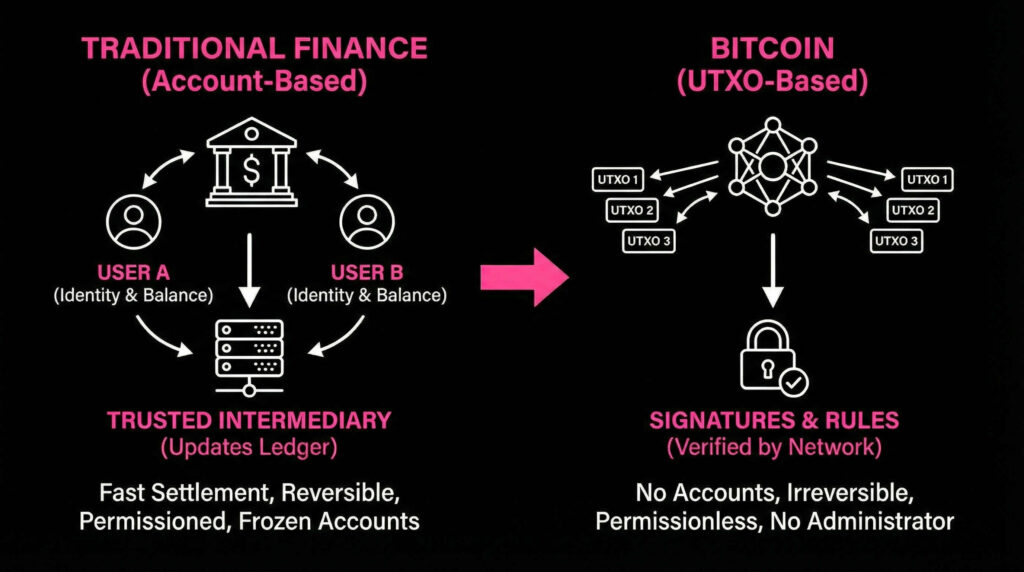
Next is the UTXO model (Unspent Transaction Outputs). Bitcoin doesn’t track balances. Instead, it tracks chunks of value created by past transactions. If you receive bitcoin, you receive one or more UTXOs. To spend, you reference specific UTXOs as inputs and create new outputs. Any leftover value becomes a “change output” back to you. This model makes verification simple and explicit.
Then there’s the hashing function. A hash function takes any input and produces a fixed-length output that’s extremely sensitive to change. Bitcoin uses hashes to link data together and to make tampering obvious. Change even one detail, and the hash breaks.
Finally, blocks and the ledger are quite important. Transactions are grouped into blocks. Blocks reference the previous block by hash, forming a chain. This makes the ledger append-only. One can add new history, but altering old history would require redoing everything after it.
These concepts aren’t optional features. They’re the smallest possible toolkit needed to build a system where ownership, ordering, and verification, work without trust.
How All This Bitcoin Stuff Works In Practice
Now we can walk through what actually happens when someone sends a Bitcoin transaction, the gradual step by step, without shortcuts involved.
It begins with choosing inputs. Your wallet looks at the UTXOs you control and selects one or more that add up to the amount you want to send, plus a transaction fee. This is why Bitcoin feels different from account-based systems. You’re not subtracting from a balance, you’re spending specific pieces of value.
Next comes creating outputs. One output sends bitcoin to the recipient’s address. If your inputs are larger than the amount you’re sending, another output sends the remainder – called change, back to an address you control. This happens automatically, but it’s an important detail. Most transactions create change.
Then the transaction is signed. Your wallet uses your private key to sign the transaction data. This signature proves that you’re authorized to spend those specific UTXOs. Nothing is broadcast yet but this step is purely cryptographic.
After signing, the transaction is broadcast to the network. It’s sent to nearby nodes, which independently verify it. They check that the signatures are valid, the inputs exist and are unspent, and the transaction follows all protocol rules. If it passes, the transaction enters the mempool, which is a holding area for valid but unconfirmed transactions.
At this point, the transaction is not final. It’s valid, but it can still be replaced or dropped if network conditions change.
This is where fees matter. Bitcoin fees are not percentages. They’re based on data size which is measured in bytes. Transactions offering higher fees are more attractive to miners because block space is limited. When the mempool is crowded, lower-fee transactions may wait longer.
Nothing about this process requires permission. There’s no account approval, no central scheduler, and no trusted intermediary. The transaction is either valid under the rules or it is not.
So far, we’ve created and shared a transaction. Next, we’ll look at how it actually gets recorded permanently.
Real World Example or Scenario
To make all of this concrete, let’s walk through a simple, realistic example. This is the kind of transaction that happens on Bitcoin every day.
Imagine Alice wants to send bitcoin to Bob.
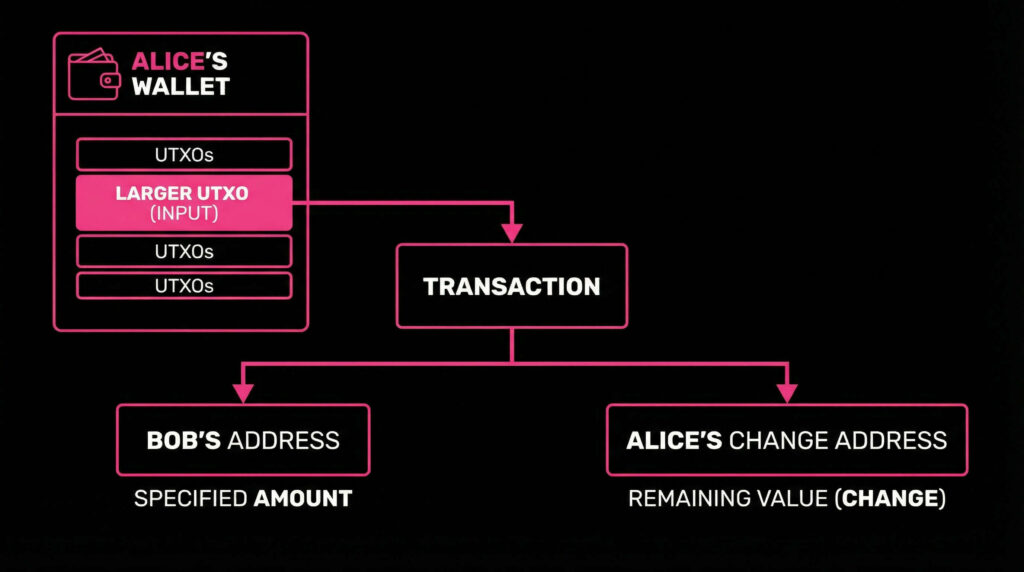
Alice opens her wallet and enters Bob’s address along with the amount she wants to send. Behind the scenes, the wallet scans Alice’s UTXOs which are unspent transaction outputs she controls. Suppose Alice doesn’t have one UTXO that exactly matches the amount. Instead, she has a larger one.
Her wallet selects that UTXO as an input. Now the wallet constructs the outputs. One output sends the specified amount to Bob’s address. Another output sends the remaining value back to Alice as change. This often surprises people the first time they learn it, but it’s normal.
Most Bitcoin transactions generate change, just like paying cash with a large bill.
Next, the wallet estimates a fee. If Alice wants the transaction confirmed quickly, the wallet suggests a higher fee. If she’s willing to wait, it suggests a lower one. Alice chooses, and the fee is implicitly defined as the difference between the total inputs and total outputs.
The transaction is then signed using Alice’s private key; at no point does Alice reveal her key. She only produces a signature that proves authorization to spend that specific UTXO.
Once broadcast, the transaction enters the mempool. Bob may see the transaction almost immediately as “pending”, but nothing is final yet. If Bob accepts zero confirmations, he’s trusting that the transaction won’t be replaced or conflicted.
When a miner eventually includes the transaction in a block, it receives its first confirmation. That confirmation doesn’t make the transaction magically irreversible, but it does anchor it into the blockchain. Each additional block added afterward increases the cost of undoing it.
What this example shows is important.
Bitcoin doesn’t move balances. It consumes old outputs and creates new ones, with verification at every step. Wallets hide this complexity, but the rules are always there, working quietly in the background.
Five Common Myths & Misunderstandings
At this point, most confusion around Bitcoin doesn’t come from the mechanics themselves. This not knowing comes from incorrect mental shortcuts people pick up along the way. Clearing these up is essential before moving forward.
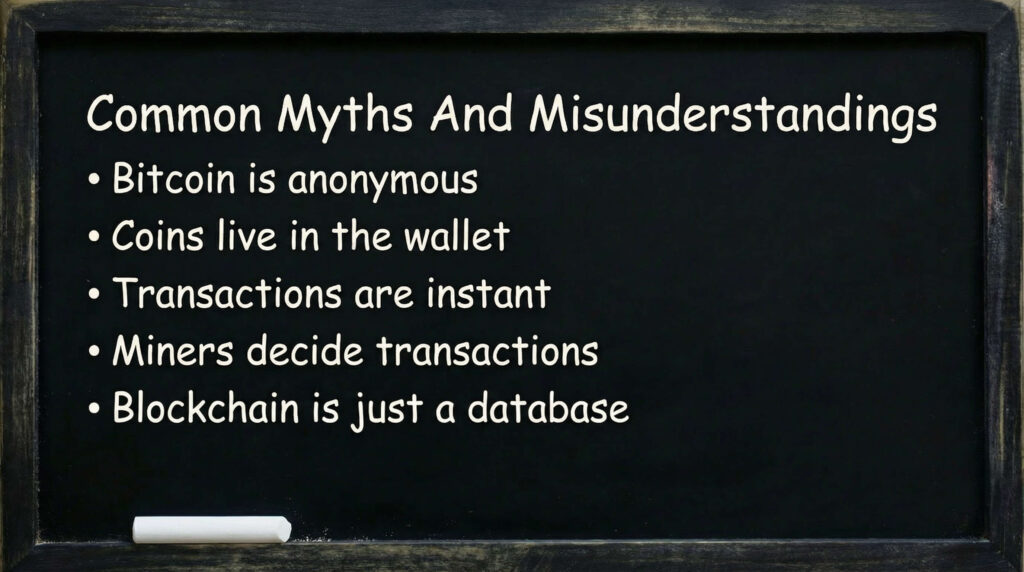
Myth 1: Bitcoin is anonymous.
Bitcoin is better described as pseudonymous. Addresses are not tied to names by default, but every transaction is public and permanently recorded. Once an address is linked to a real-world identity, through exchanges, merchants, or behavior, its transaction history becomes traceable. Bitcoin prioritizes verifiability, not secrecy.
Myth 2: Coins live inside your wallet.
They don’t. Bitcoin never leaves the blockchain. What your wallet actually holds are private keys that give you the ability to authorize spending specific UTXOs. The ledger tracks ownership. The wallet just manages keys and creates valid transactions on your behalf.
Myth 3: Transactions are instant.
Broadcasting a transaction is fast. Finality is not. Until a transaction is included in a block, it can be replaced or dropped. Even after inclusion, it becomes more secure gradually as additional blocks are added. Bitcoin trades speed for verifiable settlement over time.
Myth 4: Miners decide which transactions are valid.
Miners do not create rules. They follow them. Every full node independently verifies transactions and blocks. If a miner includes an invalid transaction, nodes reject the block entirely. Miners can choose which valid transactions to include, but they cannot change the rules of validity.
Myth 5: The blockchain is just a database.
It’s more than that. A traditional database can be edited by whoever controls it. Bitcoin’s ledger is append-only and globally verified. Its security doesn’t come from access control. It comes from cryptography, consensus, and cost.
These misunderstandings matter because they lead people to overestimate what Bitcoin protects them from or underestimate what it requires from users. Once these myths are removed, Bitcoin becomes easier to reason about, not harder.
With that clarity in place, we can now talk honestly about risks.
The Overall Bitcoin Risk Analysis
Understanding how Bitcoin works also means being clear about what it does not protect you from. Bitcoin removes certain risks, but it also shifts responsibility to the user in ways traditional systems don’t.
The most fundamental risk is key loss.
If you lose your private keys, there is no recovery process. No support desk. No password reset. The network has no concept of identity, only valid signatures. From Bitcoin’s perspective, lost keys are indistinguishable from intentional long-term holding. This is not a flaw; it’s a consequence of eliminating centralized control.
Closely related is custody risk.
If you don’t control your private keys, you don’t directly control your bitcoin. Custodial services can be convenient, but they reintroduce trusted intermediaries, along with counter-party risk, withdrawal limits, and potential censorship. Bitcoin allows self-custody, but it doesn’t force it. That choice comes with tradeoffs.
There are also transaction-level risks.
During periods of high network activity, fees can spike and confirmation times can increase. A transaction with too low a fee may sit in the mempool for hours or days. This doesn’t break Bitcoin. Though it does require users to understand fee dynamics and confirmation expectations.
At the network level, there are rare but real technical risks.
Short blockchain reorganizations can happen when two miners find blocks at nearly the same time. These reorgs are usually only one or two blocks deep and resolve quickly, but they’re the reason confirmations matter. Bitcoin offers probabilistic finality, not instant settlement.
Finally, there is the fact of user error.
Sending funds to the wrong address, misunderstanding change outputs, or falling for phishing attempts are among the most common ways people lose bitcoin. The protocol enforces rules consistently, but it doesn’t protect against mistakes made before a transaction is signed.
The important takeaway is the following. Bitcoin minimizes trust in others, but maximizes responsibility for yourself. So deal with it responsibly.
That tradeoff is intentional. And once you understand it clearly, you can decide when, and whether, it’s appropriate for your own use case.
Bitcoin Opportunity Analysis
After discussing risks, it’s important to understand why Bitcoin’s design choices can still be valuable, despite the responsibility they place on users. This section isn’t about upside or returns; it’s about capabilities that are difficult to replicate with other systems.
One of Bitcoin’s core opportunities is censorship resistance.
Because transactions are validated by a decentralized network of nodes, no single party can arbitrarily block a valid transaction. As long as you follow the rules and can broadcast to the network, your transaction is treated the same as anyone else’s. This doesn’t make Bitcoin invisible or unstoppable though it does make it difficult to selectively exclude participants.
Another key feature is predictable monetary policy.
Bitcoin’s issuance schedule is defined in code and enforced by nodes. New supply enters the system at a known rate, and that rate declines over time. This doesn’t make Bitcoin better money by default, but it does make its monetary behavior transparent and difficult to change without widespread agreement.
There is also settlement finality over time.
Bitcoin doesn’t offer instant finality. Instead, it offers something different: the longer a transaction remains buried under subsequent blocks, the more costly it becomes to reverse. For large-value or cross-border transfers, this gradual finality can be a feature rather than a flaw.
Finally, Bitcoin offers self-custody optionality.
You are not required to trust a bank, platform, or payment processor to hold or move value on your behalf. You can choose convenience or control. That flexibility doesn’t eliminate risk. This flexibility gives users options that traditional systems often don’t.
The unifying theme here is optionality with Bitcoin usage.
Bitcoin doesn’t force a single way of interacting with money. It provides a set of guarantees and tradeoffs and lets users decide when those tradeoffs make sense.
Comparison or Alternative View
Understanding Bitcoin fully also means understanding what it is not. Many misconceptions come from comparing Bitcoin to systems that look similar on the surface but operate on very different assumptions underneath.
Start with traditional banks and payment apps.
These systems use an account-based model. You have a balance associated with an identity, and a trusted institution updates that balance when you transact. Settlement is fast and user-friendly and it depends entirely on intermediaries. Transactions can be reversed, accounts can be frozen, and access is permissioned. Bitcoin deliberately avoids this model. There are no accounts, no balances, and no administrators… only UTXOs and signatures verified by rules.
Now compare Bitcoin to smart contract platforms like Ethereum.
Ethereum uses an account and state-based model rather than UTXOs. This makes complex applications easier to build, but it also increases system complexity and the surface area for bugs or unintended behavior. Bitcoin’s design is more constrained. It prioritizes simplicity, auditability, and minimizing changes over expressiveness.
Then there are custodial crypto platforms.
From a user perspective, these often feel like Bitcoin, but they aren’t. When you use a custodial service, you’re interacting with an internal database. Transfers are fast because they’re not on-chain. You gain convenience, but you give up the guarantees Bitcoin provides at the protocol level. The system works until trust breaks.
Finally, there are alternative consensus models, such as proof-of-stake.
These systems replace energy cost with capital-based influence. That tradeoff has advantages and drawbacks. Bitcoin’s proof-of-work model is intentionally expensive, because that cost is what makes rewriting history difficult. Different systems optimize for different goals.
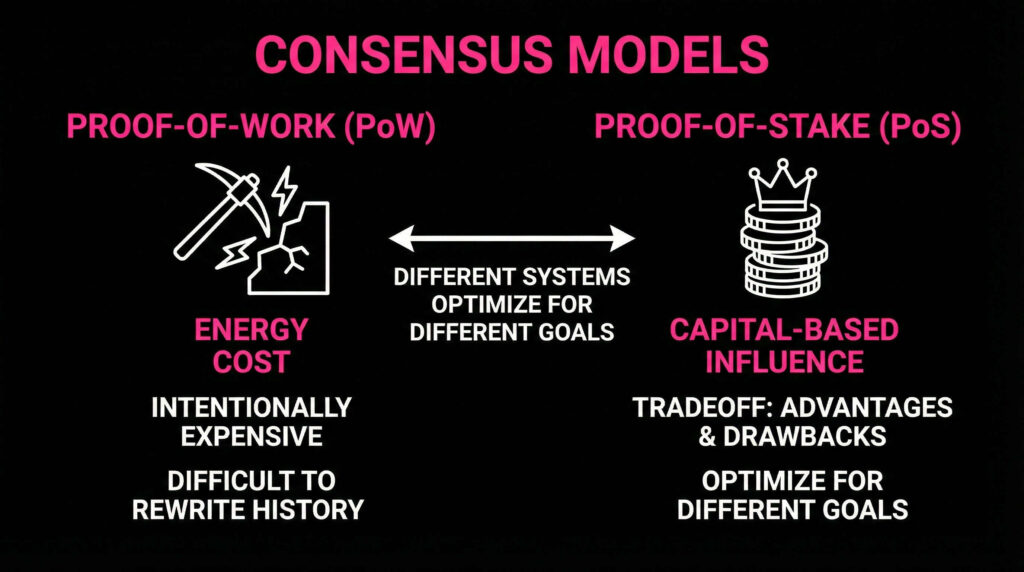
Bitcoin is not trying to be the best at everything. It is optimized for verifiable ownership, simple rules, and resistance to unilateral control. Once you see those comparisons clearly, Bitcoin’s limitations stop looking like oversights and actually begin looking like deliberate design choices.
Bitcoin Long-Term Implications (No Price Predictions)
When people think about Bitcoin long term, they often focus on outcomes that are usually price-related. A more useful way to think about the future of Bitcoin is through the implications of its design choices, because those choices constrain how the system can evolve.
One major implication is Bitcoin’s security budget.
Today, miners are compensated through a combination of block subsidies (newly issued bitcoin) and transaction fees. Over time, the block subsidy decreases according to a fixed schedule. This means transaction fees are expected to play a larger role in securing the network. Whether that transition happens smoothly depends on usage, fee markets, and how much value users place on on-chain settlement.
Another implication is the intentional conservatism.
Bitcoin changes slowly by design. Upgrades require broad agreement across developers, node operators, and miners. This makes innovation slower, but it also reduces the risk of unintended consequences. In Bitcoin, stability is treated as a feature, not a limitation. The system optimizes for being predictable and difficult to change rather than fast to evolve.
Then there are also implications around scaling.
Bitcoin prioritizes decentralization at the base layer, which limits how many transactions can be processed directly on-chain. Instead of pushing all activity onto the base layer, scaling tends to happen through layers and systems built on top. This preserves the simplicity of the core protocol while allowing flexibility elsewhere.
Decentralization itself creates tradeoffs.
Running a full node must remain accessible to ordinary users, or the network risks concentrating power. That constraint influences block size, validation rules, and hardware requirements. Bitcoin consistently chooses wider verification over higher throughput.
The long-term picture is not one of perfection or inevitability. It’s a system shaped by deliberate constraints. Bitcoin’s future behavior, like how it scales, how it’s used, and how secure it remains, will be a direct result of these choices, not market sentiment or short-term trends. Understanding that helps frame Bitcoin as an evolving system with boundaries, rather than a product chasing constant optimization.
How To Think About Bitcoin in The Current Time
This section is about building a practical mental model for interacting with Bitcoin safely and realistically. Not rules to follow blindly, but questions to ask before you act.
Start by thinking in threat models, not guarantees. Ask yourself: what am I protecting against in this situation? For small, everyday amounts, convenience may matter more than maximum security. For larger transfers or long-term storage, the threat model changes. Bitcoin doesn’t offer one-size-fits-all safety. However, it offers tools that scale with how carefully you use them.
Next, understand confirmations in context. Zero confirmations mean a transaction is merely broadcast. One confirmation anchors it into a block. Each additional confirmation increases the cost of reversal. The “right” number of confirmations depends on the value at risk and your tolerance for uncertainty. Finality in Bitcoin is probabilistic, not instant.
Custody is another critical dimension. If you self-custody, you eliminate counter-party risk, but you take on operational risk. That means thinking about backups, recovery phrases, and how private keys are stored and accessed. If you use a custodian, you’re trading some control for convenience. The key is recognizing the tradeoff clearly, not pretending it doesn’t exist.
Fee strategy also matters. Bitcoin fees fluctuate based on demand for block space. A calm approach is to treat fees as a market signal rather than a nuisance. Higher fees buy priority. Lower fees buy patience. Knowing when each makes sense prevents frustration and mistakes.
Finally, separate verification from trust. Bitcoin’s core promise is that you don’t need to trust anyone if you’re willing to verify. Running a full node is the most complete form of verification, but even without one, understanding what is being verified on your behalf helps you reason about risk.
This framework won’t make Bitcoin simple. But it will make it legible, and that’s the difference between using the system deliberately and reacting to it blindly.
The Final Reality Check And Summary
At the end of all these mechanics, it’s worth stepping back and compressing Bitcoin into a single, accurate mental model as one that replaces mystery with structure.
Bitcoin is not a company. It’s not an app. And it’s not a promise that things will always work out in your favor. Bitcoin is a consensus system.
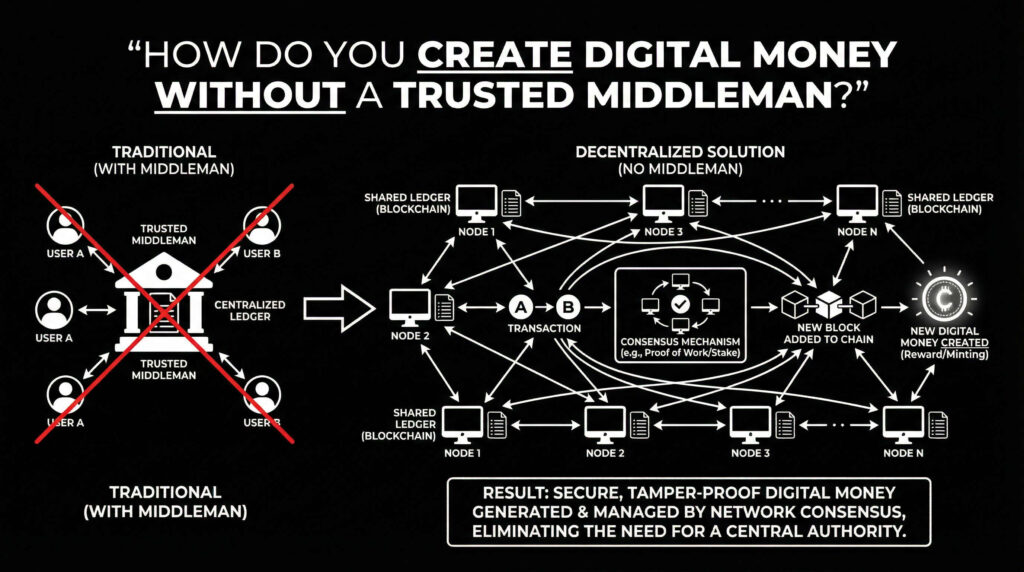
Ownership is proven with digital signatures and not accounts. Transactions are validated by rules, not by approval. Blocks are ordered by proof-of-work, not by coordination or trust. And the ledger persists because changing it is economically expensive, not because someone is in charge.
When you send bitcoin, you’re not asking permission. You’re creating a transaction that either follows the rules or doesn’t. Every node checks those rules independently. If the transaction is valid, it propagates. If it’s not, it’s ignored. There is no escalation path beyond verification.
Miners don’t decide what Bitcoin is. They compete to order transactions into blocks, and they get paid only if the rest of the network accepts their work. Nodes enforce the rules. Miners supply ordering and security. Users supply transactions. Each role is limited and that limitation is intentional.
Finality in Bitcoin is gradual. Each block added on top of yours increases the cost of rewriting history. There’s no moment where a transaction becomes magically irreversible, only a point where reversal becomes impractical. That’s a tradeoff Bitcoin makes openly.
Seen clearly, Bitcoin isn’t fragile because it lacks a central authority. It’s resilient because it does. Nothing here requires belief. You don’t have to agree with Bitcoin’s goals to understand how it works. Once you see the system step by step, it becomes something you can evaluate on its actual design not on headlines, hype, or fear. Bitcoin either makes sense to you at the level of mechanics or it doesn’t. But at this point, it should no longer be a black box.
You’ve seen that Bitcoin doesn’t rely on belief, trust, or permission. It relies on clear rules, independent verification, and incentives that make dishonest behavior expensive. Every part of the system, from keys and transactions to blocks and confirmations, exists for a specific reason. Nothing is decorative. Nothing is accidental.
That perspective changes how you approach everything else. Future topics like mining, fees, scaling layers, custody, or even volatility stop feeling like isolated debates. They become extensions of the same core system you’ve already seen: a network optimized for verifiable ownership and resistance to unilateral control, even if that means accepting constraints and tradeoffs.
You don’t need to agree with Bitcoin’s philosophy to understand its design. And you don’t need to use Bitcoin to benefit from understanding how it works.
The value of this foundation is clarity. When something breaks, slows down, or behaves differently than expected, you now have a framework to ask why, instead of guessing or relying on slogans.
Leave a Reply