Sending cryptocurrency often feels instant and almost effortless. You open a wallet, paste an address, choose an amount, and press send. Within minutes or even seconds, value appears to move across the world without a bank, without permission, and without anyone approving the transaction.
But that simple experience hides a detailed and carefully designed process.
This article explains exactly what happens when you send crypto, step by step, using plain language and no hype. By the end, you’ll understand what is really happening behind the scenes and why crypto works the way it does.
Step 1: You Enter the Recipient Address
Every crypto transaction starts with an address.
A crypto address works similarly to a bank account number or an email address. It tells the network where the funds should go. However, unlike a bank account, a crypto address does not include your name or personal identity. It only represents control.
When you paste an address into your wallet, you are telling the network that value should be sent to whoever controls the private key for that address.
At this point, no cryptocurrency has moved. Nothing is public yet. You are simply preparing instructions.
Step 2: Your Wallet Creates Transaction Message
Your wallet does not directly move coins or tokens.
Instead, it creates a transaction message that includes the sender address, the recipient address, the amount being sent, a transaction fee, and supporting technical data.
This message is an instruction, not money itself. A useful comparison is writing a check. The check is not cash. It is an authorization that allows funds to move.
At this stage, the transaction still exists only inside your wallet.
Step 3: Your Wallet Proves You Are Allowed to Send
This is one of the most important steps.
Your wallet uses your private key to digitally sign the transaction. This signature proves that you control the funds being sent, that you approved the transaction, and that the transaction data has not been altered.
Your private key never leaves your wallet. It is never shared with the network. Instead, the network sees a cryptographic signature that can be verified mathematically.
This is why private keys matter so much. If a private key is lost, access is lost permanently. There is no password reset and no customer support that can recover it.
Step 4: The Transaction Is Broadcast to The Network
Once signed, the transaction is sent to the crypto network through a node. A node is a computer running the blockchain software and connected to other nodes around the world.
At this point, the transaction becomes public. Anyone can view it. However, it is not final yet.
The transaction enters a waiting area commonly called the mempool, short for memory pool. This is where unconfirmed transactions wait until they are processed.
Step 5: The Network Checks If Transaction Is Valid
Before a transaction can be confirmed, the network checks several rules automatically.
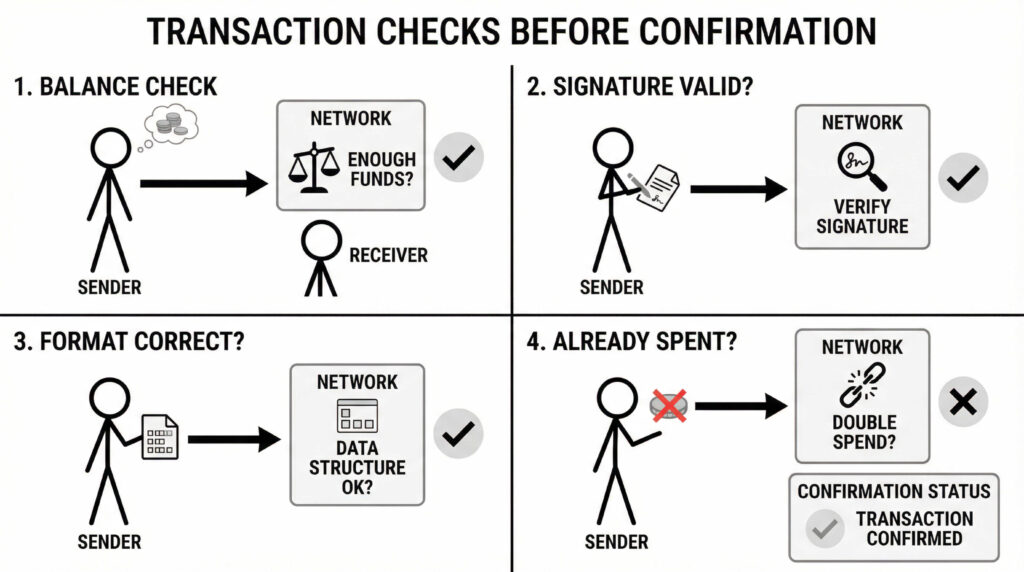
It checks whether the sender has enough balance, whether the digital signature is valid, whether the transaction is formatted correctly, and whether the sender is trying to spend funds that were already spent.
If any rule fails, the transaction is rejected. No funds move and nothing changes in the wallet.
There is no human approval involved. These checks are enforced entirely by software.
Step 6: Miners or Validators Select The Transaction
Different blockchains use different systems to process transactions.
Some use miners, while others use validators. Their role is to select transactions from the mempool and include them in the next block.
Transaction fees play an important role here. Fees act as an incentive and a priority signal. Transactions with higher fees are usually processed faster, while lower-fee transactions may wait longer.
This fee system also helps prevent spam by making large-scale abuse expensive.
Step 7: Transactions Are Grouped Into a Block
Selected transactions are grouped together into a block.
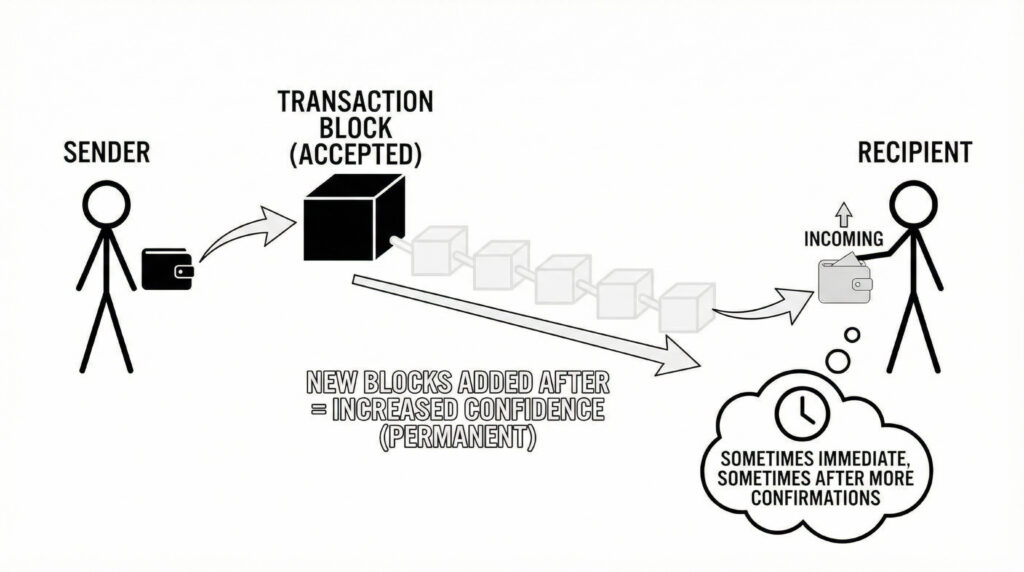
A block contains multiple transactions, a reference to the previous block, and technical data that secures the chain.
Each new block links to the one before it, forming a continuous chain of blocks. This structure is where the term blockchain comes from.
Step 8: The Network Reaches Consensus
Before a block becomes official, the network must agree that it is valid. This process is called consensus.
Other nodes independently verify every transaction in the block, confirm that all rules were followed, and ensure that nothing was altered.
If the block is valid, it is accepted and added to the blockchain. If it is invalid, it is rejected.
Consensus prevents fraud, double spending, and unauthorized changes to the ledger.
Step 9: The Transaction Is Confirmed
Once the block is accepted, your transaction becomes confirmed.
Your wallet updates to reflect the deducted balance. The recipient’s wallet shows the incoming transaction, sometimes immediately and sometimes after additional confirmations.
Each new block added after this one increases confidence that the transaction is permanent.
Step 10: The Transaction Becomes Practically Irreversible
After enough confirmations, reversing a transaction becomes extremely unlikely. It would require massive control over the network and enormous expense.
This is why crypto transactions are final by design. There is no undo button and no chargeback system.
Why This Feels Different From Bank Transfers
Bank transfers rely on trusted institutions and centralized systems. Reversals are possible, and settlement often happens behind the scenes over several days.
Crypto works differently. Settlement happens on a public ledger, enforced by protocol rules rather than institutions. Finality occurs at the network level.
Neither system is perfect. They simply prioritize different goals.
What Happens If You Make a Mistake?
If you send crypto to the wrong address or use the wrong network, the transaction can still succeed technically but result in lost funds.
The network does not evaluate intent. It only checks whether the transaction follows the rules.
This is why it is important to double-check addresses, use small test transactions, and understand networks before sending large amounts.
Why Fees and Speed Vary
Not all blockchains are designed the same way.
Transaction speed and cost depend on network congestion, block size, consensus method, and fee market design.
Some networks prioritize speed. Others prioritize decentralization or security. These differences explain why fees and confirmation times vary widely.
What Did Not Happen
- No bank approved the transaction.
- No identity verification was required.
- No office hours applied.
- No geographic restrictions existed.
The rules were enforced automatically by the network.
The Big Picture
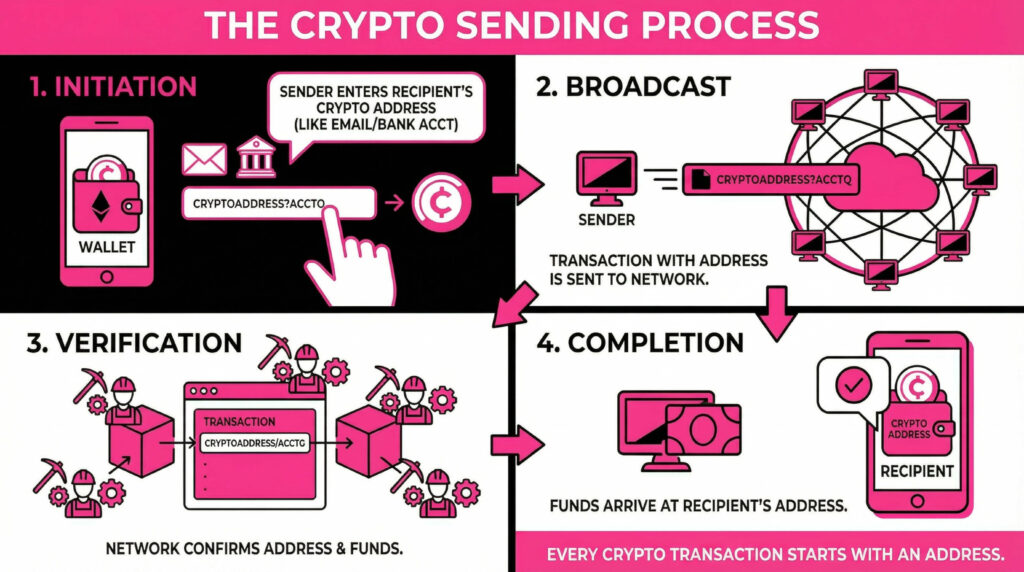
When you send crypto, you are not sending files or moving physical coins. You are publishing a signed message to a global ledger that thousands of computers verify independently.
Trust is replaced with verification.
Crypto transactions are not magic. They are systems built on rules, math, and consensus. Understanding what happens step by step makes crypto less confusing and reduces the risk of mistakes. That understanding, more than speculation or price movement, is where real value begins.
Leave a Reply